All posts by Nathan

Kentucky Vintage

The selection of Kentucky Vintage was not the result of the most pointed recommendation process.  I had never read or heard anything about it and it was recommended to me at LeNell’s only after it became clear that I had already exhausted the my guide’s first few rounds of suggestions.  That’s what this blog is all about though, right?

Kentucky Vintage comes to us from the folks who make Johnny Drum, Rowan’s Creek, and a few other familiars on liquor store shelves.  Judging by their website, Kentucky Bourbon Distillers has a broad and slightly disorganized product range in a variety directions – all the more for us to taste, I suppose.

Presentation:

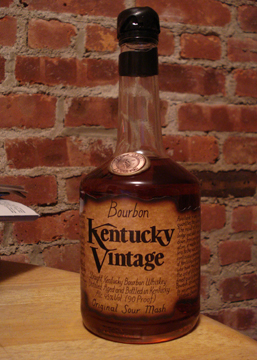
The labeling on Kentucky Vintage seems to be a distillation of everything I complain about in bourbon labels: faux-aged, faux-burnt edges, Comic Sans-esque lettering, and (three!) long winded descriptions.  To top it off, they’ve dipped the plastic screw-top in wax.  Yet, to their credit, it seems their hand-numbering is legit, as is their medallion pressed into wax on the front.

The bourbon is small batch, 90 proof, and of an age only described as “long beyond that of any other bourbon,” hmmm.  This doesn’t mean anything other than it’s older than four years, legally, but it would be nice to imply a range from which they’ve selected.

Tasting:

To the nose Kentucky Vintage is pleasant, if subdued.  Dominated largely by char and a saltiness, there are also notes of sweet pears and oak.  It is neither rough nor complex, but hits a middle ground that just misses the “boring” range and lands in “pleasant”.

On tasting KV’s dominant sensation is saltiness start to finish.  Further inspection reveals that there isn’t too much more than that except corn and a hint of char in the middle.  This really tastes much greener than something aged “long beyond that of any other bourbon” should taste.  In a blind tasting, I’d be surprised if this were even four years.

Over all:

I was hoping that the clumsy presentation of Kentucky Vintage reflected an honest concentration on the bourbon itself – as it should be – but I was ultimately disappointed.  Judging by the range of bourbon sold by Kentucky Bourbon Distillers, they would do well to take a hard look at some of their expressions.
Old Pogue, Master’s Select

Old Pogue Master’s Select came recommended to me after I told the woman helping me that I particularly liked the Old Forester I had last week.  It seems appropriate to make a comment about Dirty Old Towns or something along those lines, but that would just be too obvious, wouldn’t it?

Presentation:

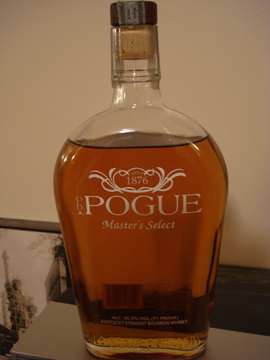
Old Pogue Master’s Select’s bottle is quite attractive.  It’s simple, the typeface is elegant without being showy, and most importantly, it shows off the bourbon very well.  Its not-overly-sloped slides and relative slender profile direct light pleasingly through the amber tones within.  The hand-numbering is always a nice touch as well.

However, OPMS succumbs to the urge of burdening their product with over-wrought nostalgic tales in the little attached booklet.  Stories of how OP is somehow the most authentic bourbon lead in to tales of the Civil War and early Kentucky settlers.  Honestly, these kind of stories don’t mean a thing if your product isn’t good.

So let’s give this a try.

Tasting:

To the nose, Old Pogue Master’s Select comes across with dry hay and plenty of proof.  Deeper in, there are elements of wet slate and generally a wetness (moss, bark, grass, etc) that belies the first impression of dry hay.  I wish this weren’t so harsh, I feel like there’s much more I’m missing here.

On the palate OPMS is surprisingly sprightly.  It definitely tastes quite green and a little under done, but that initial rush is exciting.  It is definitely sweet, with elements of that hay from the nose, but them moves in to a slightly tart mango – all along with the clear impression this is green, corn whiskey.  As these intitial impressions fade, there arrives a bit of a more savory sensation like a young, un-peated Scotch (barleyish) – a little bizzare actually.   The finish is quite clean.

Over all:

I really think that Old Pogue Master’s Select could do with more time in the barrel.  The over all impression is largely that of immaturity and over-proof – even though it isn’t even 50%.  Needless to say this has very little in similarity to the Old Forester I tasted last week.

Old Forester Birthday Bourbon – 2007

I’ve never read a bad word about the Old Forester Birthday Bourbon series, so I was excited to try this one out.  I also tried out a new liquor store today, Wine Exchange, which didn’t have the greatest selection, but the manager was very friendly – asking what he should add to his bourbon offering. With any luck, this implies that we’ll have a decent source of bourbon in the neighborhood soon.

Presentation:

Old Forester Birthday Bourbon comes in a squat little bottle with a hearty cork stopper.  Its labeling is not over done and quite tasteful.  It doesn’t pander to the nostalgists but it does have a weighty feel to the branding.  The bottle itself isn’t burdened by origin stories or lists of awards – those are relegated to a little booklet attached to the neck.  Perhaps this is out of respect for those of us that prefer a vessel unadorned by too much text, but more likely it is simply because the number of awards this series has won can only fit in such a separate booklet.

Tasting:

To the nose Old Forester Birthday Bourbon 2007 is rich and smooth.  It’s dominated by sweet caramels, buttercreams, andcomes across without any sharp edges.  Each scent layers easily with the next.  Quite attractive.

On the palate OFBB can give some of my favorite single malt scotches a run for their money.  It opens with a citrusy tartness that recalls lemon drops and pineapple.  This drops into a sensation that borders between the saltiness of Talisker and freshly baked cupcake.  Next a cool mintiness creep up from the back then fades into a long, moderately warm finish with only the slightest notes of oak looking in on the edges.  Very well done.

Over all:

This 2007 edition is very impressive.  It is quite complex without brashness of a Knob Creek or any sharp angles to speak of.  For a bourbon aged 13 years, I’m surprised by how free of wood it is –  as though it traded in the wet oak aspects for a subtlety and variety of character not often seen.

This is possibly my favorite selection since starting this blog.

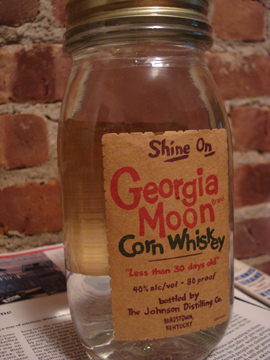
Shine On Georgia Moon Corn Whiskey

While the rest of my borough is out partying, I’ve taken a break to bring a new whiskey into my arsenal.  Shine On Georgia Moon is something that’s caught my eye on the shelf every time I visit my local liquor store, so instead of venturing down to Red Hook to see my usual pushers at LeNell’s I opted to give SOGM a try.

Presentation:

Shine On Georgia Moon is bottled and positioned for one purpose and one purpose only: to hammer home the idea that it is moonshine.  From the name, to the mason jar, to the irregular typeface on the shopping-bag-paper label, this liquor is anything but subtle.  Thankfully they realize that they are so unapologetically forward in their visual presentation that they didn’t find the need to add a hokey little narrative about some old-timey man and his still out in the back woods of Georgia (or Kentucky as is the case here).

Beyond these obvious points, there is one message that seems particularly distictive to this brand – they proult declare that their product is “less than 30 days old” right on the front label.  This is a clear response to the often fetishistic focus on a whiskey’s age that we see in other brands.  SOGM seems to be trying to make the “freshness” of the product a selling point…not a crazy approach in the era of local food and farmers’ markets.

If you take the cheap bottling and quick time to market implied in the “less than 30 days old” tag line, and place these two qualities next to the $13+ price point, what you see is some damn shrewed marketing.  The Johnson Distilling Company has taken the market’s obsession with notions of “authenticity” and manufactured unpretentiousness and turned it into a cheap-to-make, mid-market brand.  Bravo.

Tasting:

Shine On Georgia Moon is no subtler to the nose than its bottling is to the eye.  Before even getting to the nose however, one must struggle to pour the whiskey out of the mason jar itself – not an easy task to complete neatly.  Once in the glass, SOGM definitely smells like whiskey, but very green whiskey.  The dominant scent is (naturally) corn, but it really smells like the mash itself, unaged, unmellowed.

On the palate, SOGM is equally young.  It moves quickly through its seasons: starting with a burst of corn, dropping into the sensation of boiled mash, then disappearing as quickly as it came leaving only a slight remembrance in the clean finish that something had passed this way.  There seem few better ways to describe it than simply as ‘fast’.

Over all:

I would probably never find myself settling down with a glass of neat Georgia Moon any day soon, but that doesn’t mean there aren’t good uses for a green whiskey such as this.  For instance, I can imagine with a little simple syrup and mint this would make a fine julep; or perhaps replace the mint with a wedge of lime and the simple syrup for cane syrup for a variation on Ti’punch.  In fact, SOGM reminds me more of a rhum agricole than a bourbon or any other American whiskey – so it might be best to treat it as such.

Virginia Gentleman 90, small batch

Virginia Gentleman is perhaps the best known non-Kentucky bourbons, yet this distinction is only partly true since the Smith Bowman distillery takes new distillate from Buffalo Trace (in Kentucky) then distills it for a 3rd time at their Virginia location, where it is also barreled and aged. I suppose that’s good enough.
Presentation:

VG90 is the small batch, premium expression of the brand. The bottle is dominated by gold – in the waxed neck, the labels, and the text – but otherwise attempts to exude a subdued, genteel dignity. This is expressed with the spare descriptive text on the back and the prominent fox hunt painting that serves as the primary branding imagery on the front. The bottle itself is an attractive and simple shape that draws the eye toward the action in the label.

Tasting:

The most impressive elements of Virginia Gentleman 90 were the initial scent when opening the bottle and its impression on the nose after pouring. To the nose it has a strong yet smooth character. It is assertive in its presence, but not in its character, built with scents of kettle corn, sea-breeze, and wet grass. I really quite enjoyed this aspect which sets the table for the actual tasting.

On the palate VG90 is very smooth, yet a little boring. After an initial sweetness that vaguely hints at caramel and pineapple, comes a rather neutral warmth and a clean finish. I spent a good amount of time trying to chase down further depths but to no avail.

Over all:

Virginia Gentleman 90 made an impressive opening to the nose, but on the palate is was smooth yet dull. I have to admit that I enjoyed it though. This is an excellent bourbon to bring out for company and folks who aren’t going to be up for the intricacies of something more complex. True to its theme Virginia Gentleman manages to express a subdued, genteel dignity both in vision and character.

Elijah Craig Single Barrel

I’m back from vacation and found some time to stop by LeNell’s to pick up the next couple subjects for this blog of mine.

Appearance:

This week, I tried the Elijah Craig Single Barrel.  ECSB is one of those bourbons that could go either way.  On the one hand, its placement in the higher end of the market implies (and hopefully demands) a certain level of quality, but at the same time when bourbons get up to 18 years that can sometimes be to much wood.  No on wants to feel like they’re chewing on the barrel after all.

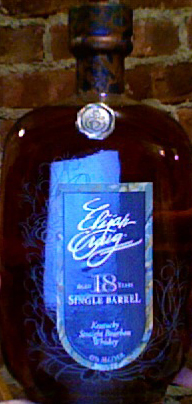
However it turned out, ECSB will make a fine aesthetic addition to any bourbon shelf.  The bottle stands out from the standard dusty-old-man school of design that most bourbons seem to adhere to.  Instead ECSB takes a decidedly more feminine approach, more like Four Roses Small Batch.  Its smooth curves and slender neck are adorned by swirls of flowers, petals, and vines and the label sports a baby-blue, gold, and white color scheme.  At the center of it all is the Elijah Craig seal, hanging like a silver pendant on a debutante’s neck (sadly, this seal is made of what seems to be cheap plastic).

All this does seem a little over-done, but that just means it will provide a nice visual counter-weight to the creaking masculinity of the Wellers and Grand-Dads of Old.

Tasting:

To the nose Elijah Craig Single Barrel comes across quite simply and a little off-puttingly.  The stark corn and char that make up the dominant features seem out of place in such an old bourbon.  Surely these would have been tempered by their time in the oak?  I was hoping for something more at this stage.

On tasting, the first sensation is red berries, followed quickly by the sweet corn and char.  These mix and provide some heat in the middle, but are followed by a pleasant finish of freshly mowed hay that fades to wet oak – edging very close to the point of over-aged, but not quite getting there.

Over all:

Elijah Craig Single Barrel is quite smooth with a touch of heat and vigor in the middle.  The finish definitely reflects its aging, but does not go too far.  It was not as simplistic as I had feared from the scent, it was well balanced over all, and flirting with the boundary of over-agedness.

The finish is a long one.  This is a drink to take your time with.

Apologies for the low-quality picture.  My usual camera is out of service at the moment.

American Trio #1: One-Oughts

Instead of venturing into a new whiskey this week, I’ve decided to take a look back with a coordinated trio from my past conquests.  For this first tri-tasting installment, I’ve chosen to group the spirits based on a common proof range.  This will allow me to better compare the plays and counter-plays between the other aspects of the trio.

And the three are…

1. Old Grand-Dad (Bonded) – the definition of the everyman’s bourbon: sweet, corn, classic (4 years, 100 proof)
2. Knob Creek – the punchy, bold, from the Jim Beam folks (9 years, 100 proof)
3. Old Weller Antique – reasonably priced, wheated, and slow: from Buffalo Trace (7 years, 107 proof)

I start with OGD – because there is no messing around with OGD.  It is not the subtlest of bourbons to say the least.  I’m betting it’s a good base to build from.  It is just as I expected, an angular, straight-forward bourbon.

On to the Knob Creek: in comparison, it smells sweet and refreshing…almost juicy.  Letting it wash over the tongue…wow.  Knob Creek really puts OGD in its place.  Much smoother much more depth to the flavor, yet still with its familiar punch followed by slow, oaky burn.  Over several more sips, the KB becomes spicier – as I remembered it had been.  Certainly not as angular as the OGD.  These two definitely contrast, though not in the most interesting way: we all knew that Knob Creek was better to begin with.

Moving on: Old Weller Antique comes across quite strangely after the Knob Creek.  Much more medicinal than I’d tasted before, and combined with the gentler wheated entrance it’s quite a shift of gears.  The spiciness is muted in comparision to a solo tasting, but appears in a crechendo in the finish.  These two demonstrate some of the fundamental differences between the two mash bill approaches.

Over all:
This is an interesting trio.  Clearly, there is a jump in market from the OGD to the KB and OWA, but each one is unique – with the exception of their proof range.  We have a wheated bourbon and two rye bases, one aged 4 years, one aged 7 years, and one aged 9 years.

I really enjoy the oak and tang from the Knob Creek that comes through with the increased aging and the Jim Beam mash bill respectively, but the Old Weller Antique finds its place in slower times when you aren’t looking for the muscle of Knob Creek.

As for Old Grand-Dad?  Well, good bless the fellow, he just makes the other ones taste better.

Bernheim Original

When it comes to wheat whiskey there’s usually one name that comes to mind above most others – Bernheim. So this week I finally took the plunge and gave it a serious look.

Presentation:

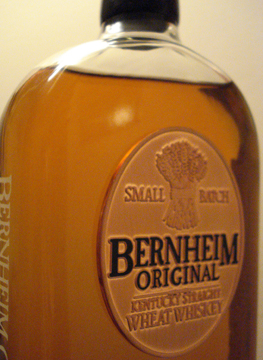
Bernheim does a great job with their bottle. It manages to be classic, classy, and simple all at once. IT doesn’t strive for some false American-whiskey past that other do. It seems to say, “we let out whiskey do the talking.”

The bottle is less than two inches in depth and uses minimal labeling. One side sports a faux-aged sticker with some text, but this is blissfully out of the way. Otherwise the main descriptive elements are the heavy copper-colored name plaque in the center of the bottle front, and the design of the bottle which lets light pass pleasingly through the yellow-amber colored liquid.

Focus here is on the drink and its attractive qualities rather than any semi-truthful origin stories. That’s the way it should be.

Tasting:

The nose is mostly mild, with hints of honey, dry grass, and hazelnut coming through. The honey is very much what I expected – the hazelnut is a bit of a surprise.

To the palate Bernheim absolutely screams “wheat!” when you first take it in. This quickly transforms into notes of unexpected spice, nuts, and green apples. Really quite complex, but not slow at all in its development. The flavors themselves may not be to aggressive, but they develop as though chased by hellhounds.

This turns into a lingering, pleasing spiciness.

Over all:

Bernheim is definitely not what I expected it to be. I was thinking I’d find a mild honey-driven whiskey, but instead was confronted by a hyper-active, but no less interesting drink with some surprising spice.

One thing that I found a little odd was how at points it reminded me of Glenfiddich – mostly at the height of its green-appley moments.

Quite a fine whiskey.

St. George Single Malt Whiskey

When I was down at LeNell’s this weekend looking for my next couple of bottles they were having an absinthe tasting – of St. George’s variety in particular.  When I probed about the company, I found that not only were thy based in the US, but that they produced a single malt whiskey as well.  So, taking a break from the march of bourbons, today I bring you St. George Single Malt Whiskey: the whiskey that wants to be a whisky.

Presentation:

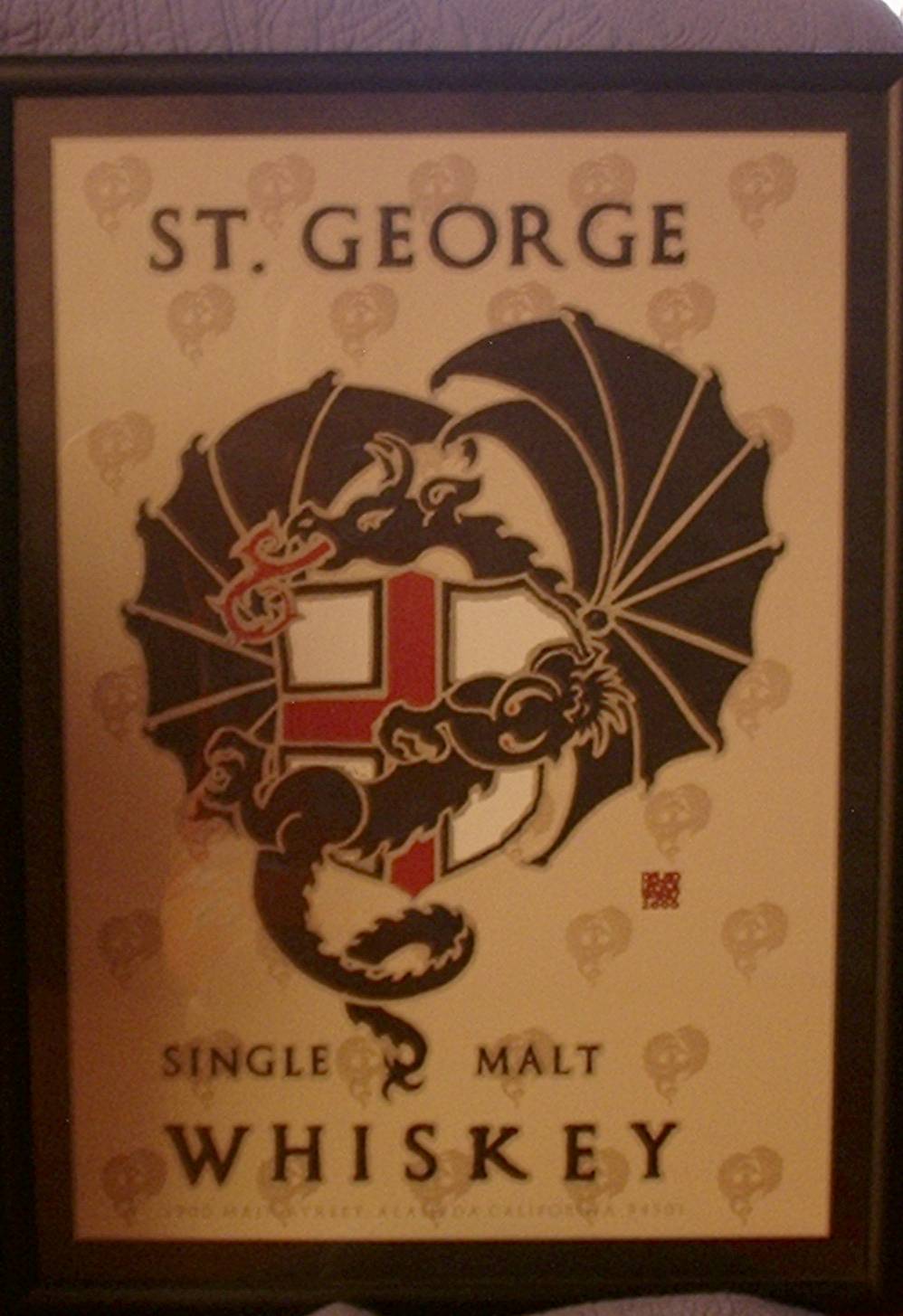
The first thing you’ll notice about SGSMW is that it does not appear to be American.  The label features  dragon clutching St. George’s cross and Celtic-esque script.

The rear label’s description says nothing of its origins, describing in only the vaguest of terms what to expect.  Really, St. George, you can’t make a single malt in America with out saying something more in-depth than telling us how complex and elegant it is?  The one tidbit they do slip in there is that this is apparently the result of “the industry’s smallest copper pot still.”

The only clues to the beverage’s New World origins are the declaration of “Alameda, CA” on the back and the fact that they spell our beloved drink with the ‘e’.  I can only think that this is deliberate.

Tasting:

SGSMW is very light in color, a testament to its time spent in used bourbon and French oak barrels – it really stands out against my growing collection of Kentucky natives.

To the nose, it is crisp and refreshing, like granny smith apples mostly.  There are also hints from the bourbon casks in the honeyed patina.  Maybe also the smell of a distant ocean.

To the palate, the granny smiths are certainly there, but quickly followed by a nutty, nutmeg-like essence.  Adding to the already full mouth feel is its sweet creaminess.  Reminds me of drinking eggnog with good spiced rum in December.

The flavors linger for some time – especially the crispness of the apple.

Overall:

I was pleased with St. George Single Malt Whiskey.  It is not an intense whiskey, it’s full of bright and friendly flavors.  I’d be interested to know how long it lived in the barrel and to try some differently aged varieties.  I think there would be much more to be gotten from the bourbon casks.

I do like that St. George did not feel obligated to take the traditional American route when producing its whiskey; it’s products like these that will allow the resurgence of whiskey consumption in this country to remain viable as more than a follow-on fad to Scotch.

Ridgemont Reserve 1792

1792 is named for the year that Kentucky became a state, but despite the 200+ year statement on the front of the bottle, this is a drink that at first look seems to strike a good balance between recognizing heritage and focusing on the contents of the bottle.

Presentation:

Beyond the central placement of 1792, only the heavy-wooden cap and the burlap ring around the neck lend 1792 a backward-looking air.  Yet even one of these (the burlap ring) manages to express heritage in a manner that is unique in the marketplace these days.

The rest of the presentation is refreshingly stark.  Very little copy on the front, clean lines on the edges, thick glass on the bottom, and a clear eschewal of old-timey script all make this bottle stand out on the shelf.  My biggest complaint is in the imitation hand-written label on the back.  Really, guys – you’re not fooling anyone with this stuff.  Either hand-label your bottles or don’t.  Pretending to be homey and individualized when you aren’t simply comes across as disingenuous.

Tasting:

One thing I really look for and enjoy is a good initial whiff when you first open a new bottle of bourbon.  This is the first impression the drink has a chance to make and it can often color the tasting to follow.

1792 has a great first-opening whiff that really gives a good sign of the bourbon to come.  The whiff is quite sweet, rounded, and largely unagressive – it’s appealing but leaves you with a curiosity about what’s deeper.

To the nose, 1792’s sweetness develops into a sensation of fresh fruit.  Beyond that is a wet grass and springtime air, very refreshing.

On the palate, 1792 is very smooth with a burst of sweet fruitiness at the end.  The finish is mild and warming, but with a very interesting pine and saltiness as a parting shot.  This saltiness is unlike anything I’ve tasted in other bourbons so far on my march through the category.  It reminds me, though, of a Talisker or Laphroaig – a bit of a kick at the end of an otherwise rounded whiskey.

Overall:

I usually enjoy punchier bourbons with several layers of flavors coming at you at once, but I have to admit that while 1792 does not do this at all, I still enjoyed it.  1792 is not all that complex but it is well rounded with simple yet full flavors.  That salty finish is really what sets it apart for me and adds a bit of a question mark at the end of a definitive statement.