Category Archives: Bourbon

Kentucky Vintage

The selection of Kentucky Vintage was not the result of the most pointed recommendation process.  I had never read or heard anything about it and it was recommended to me at LeNell’s only after it became clear that I had already exhausted the my guide’s first few rounds of suggestions.  That’s what this blog is all about though, right?

Kentucky Vintage comes to us from the folks who make Johnny Drum, Rowan’s Creek, and a few other familiars on liquor store shelves.  Judging by their website, Kentucky Bourbon Distillers has a broad and slightly disorganized product range in a variety directions – all the more for us to taste, I suppose.

Presentation:

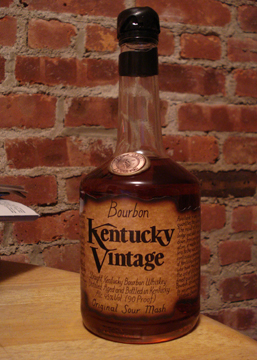
The labeling on Kentucky Vintage seems to be a distillation of everything I complain about in bourbon labels: faux-aged, faux-burnt edges, Comic Sans-esque lettering, and (three!) long winded descriptions.  To top it off, they’ve dipped the plastic screw-top in wax.  Yet, to their credit, it seems their hand-numbering is legit, as is their medallion pressed into wax on the front.

The bourbon is small batch, 90 proof, and of an age only described as “long beyond that of any other bourbon,” hmmm.  This doesn’t mean anything other than it’s older than four years, legally, but it would be nice to imply a range from which they’ve selected.

Tasting:

To the nose Kentucky Vintage is pleasant, if subdued.  Dominated largely by char and a saltiness, there are also notes of sweet pears and oak.  It is neither rough nor complex, but hits a middle ground that just misses the “boring” range and lands in “pleasant”.

On tasting KV’s dominant sensation is saltiness start to finish.  Further inspection reveals that there isn’t too much more than that except corn and a hint of char in the middle.  This really tastes much greener than something aged “long beyond that of any other bourbon” should taste.  In a blind tasting, I’d be surprised if this were even four years.

Over all:

I was hoping that the clumsy presentation of Kentucky Vintage reflected an honest concentration on the bourbon itself – as it should be – but I was ultimately disappointed.  Judging by the range of bourbon sold by Kentucky Bourbon Distillers, they would do well to take a hard look at some of their expressions.
Old Pogue, Master’s Select

Old Pogue Master’s Select came recommended to me after I told the woman helping me that I particularly liked the Old Forester I had last week.  It seems appropriate to make a comment about Dirty Old Towns or something along those lines, but that would just be too obvious, wouldn’t it?

Presentation:

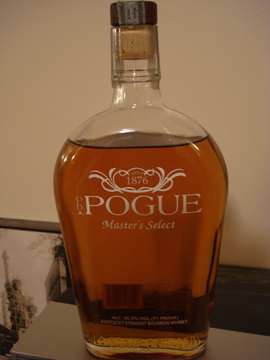
Old Pogue Master’s Select’s bottle is quite attractive.  It’s simple, the typeface is elegant without being showy, and most importantly, it shows off the bourbon very well.  Its not-overly-sloped slides and relative slender profile direct light pleasingly through the amber tones within.  The hand-numbering is always a nice touch as well.

However, OPMS succumbs to the urge of burdening their product with over-wrought nostalgic tales in the little attached booklet.  Stories of how OP is somehow the most authentic bourbon lead in to tales of the Civil War and early Kentucky settlers.  Honestly, these kind of stories don’t mean a thing if your product isn’t good.

So let’s give this a try.

Tasting:

To the nose, Old Pogue Master’s Select comes across with dry hay and plenty of proof.  Deeper in, there are elements of wet slate and generally a wetness (moss, bark, grass, etc) that belies the first impression of dry hay.  I wish this weren’t so harsh, I feel like there’s much more I’m missing here.

On the palate OPMS is surprisingly sprightly.  It definitely tastes quite green and a little under done, but that initial rush is exciting.  It is definitely sweet, with elements of that hay from the nose, but them moves in to a slightly tart mango – all along with the clear impression this is green, corn whiskey.  As these intitial impressions fade, there arrives a bit of a more savory sensation like a young, un-peated Scotch (barleyish) – a little bizzare actually.   The finish is quite clean.

Over all:

I really think that Old Pogue Master’s Select could do with more time in the barrel.  The over all impression is largely that of immaturity and over-proof – even though it isn’t even 50%.  Needless to say this has very little in similarity to the Old Forester I tasted last week.

Old Forester Birthday Bourbon – 2007

I’ve never read a bad word about the Old Forester Birthday Bourbon series, so I was excited to try this one out.  I also tried out a new liquor store today, Wine Exchange, which didn’t have the greatest selection, but the manager was very friendly – asking what he should add to his bourbon offering. With any luck, this implies that we’ll have a decent source of bourbon in the neighborhood soon.

Presentation:

Old Forester Birthday Bourbon comes in a squat little bottle with a hearty cork stopper.  Its labeling is not over done and quite tasteful.  It doesn’t pander to the nostalgists but it does have a weighty feel to the branding.  The bottle itself isn’t burdened by origin stories or lists of awards – those are relegated to a little booklet attached to the neck.  Perhaps this is out of respect for those of us that prefer a vessel unadorned by too much text, but more likely it is simply because the number of awards this series has won can only fit in such a separate booklet.

Tasting:

To the nose Old Forester Birthday Bourbon 2007 is rich and smooth.  It’s dominated by sweet caramels, buttercreams, andcomes across without any sharp edges.  Each scent layers easily with the next.  Quite attractive.

On the palate OFBB can give some of my favorite single malt scotches a run for their money.  It opens with a citrusy tartness that recalls lemon drops and pineapple.  This drops into a sensation that borders between the saltiness of Talisker and freshly baked cupcake.  Next a cool mintiness creep up from the back then fades into a long, moderately warm finish with only the slightest notes of oak looking in on the edges.  Very well done.

Over all:

This 2007 edition is very impressive.  It is quite complex without brashness of a Knob Creek or any sharp angles to speak of.  For a bourbon aged 13 years, I’m surprised by how free of wood it is –  as though it traded in the wet oak aspects for a subtlety and variety of character not often seen.

This is possibly my favorite selection since starting this blog.

Virginia Gentleman 90, small batch

Virginia Gentleman is perhaps the best known non-Kentucky bourbons, yet this distinction is only partly true since the Smith Bowman distillery takes new distillate from Buffalo Trace (in Kentucky) then distills it for a 3rd time at their Virginia location, where it is also barreled and aged. I suppose that’s good enough.
Presentation:

VG90 is the small batch, premium expression of the brand. The bottle is dominated by gold – in the waxed neck, the labels, and the text – but otherwise attempts to exude a subdued, genteel dignity. This is expressed with the spare descriptive text on the back and the prominent fox hunt painting that serves as the primary branding imagery on the front. The bottle itself is an attractive and simple shape that draws the eye toward the action in the label.

Tasting:

The most impressive elements of Virginia Gentleman 90 were the initial scent when opening the bottle and its impression on the nose after pouring. To the nose it has a strong yet smooth character. It is assertive in its presence, but not in its character, built with scents of kettle corn, sea-breeze, and wet grass. I really quite enjoyed this aspect which sets the table for the actual tasting.

On the palate VG90 is very smooth, yet a little boring. After an initial sweetness that vaguely hints at caramel and pineapple, comes a rather neutral warmth and a clean finish. I spent a good amount of time trying to chase down further depths but to no avail.

Over all:

Virginia Gentleman 90 made an impressive opening to the nose, but on the palate is was smooth yet dull. I have to admit that I enjoyed it though. This is an excellent bourbon to bring out for company and folks who aren’t going to be up for the intricacies of something more complex. True to its theme Virginia Gentleman manages to express a subdued, genteel dignity both in vision and character.

Elijah Craig Single Barrel

I’m back from vacation and found some time to stop by LeNell’s to pick up the next couple subjects for this blog of mine.

Appearance:

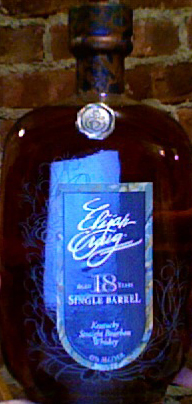
This week, I tried the Elijah Craig Single Barrel.  ECSB is one of those bourbons that could go either way.  On the one hand, its placement in the higher end of the market implies (and hopefully demands) a certain level of quality, but at the same time when bourbons get up to 18 years that can sometimes be to much wood.  No on wants to feel like they’re chewing on the barrel after all.

However it turned out, ECSB will make a fine aesthetic addition to any bourbon shelf.  The bottle stands out from the standard dusty-old-man school of design that most bourbons seem to adhere to.  Instead ECSB takes a decidedly more feminine approach, more like Four Roses Small Batch.  Its smooth curves and slender neck are adorned by swirls of flowers, petals, and vines and the label sports a baby-blue, gold, and white color scheme.  At the center of it all is the Elijah Craig seal, hanging like a silver pendant on a debutante’s neck (sadly, this seal is made of what seems to be cheap plastic).

All this does seem a little over-done, but that just means it will provide a nice visual counter-weight to the creaking masculinity of the Wellers and Grand-Dads of Old.

Tasting:

To the nose Elijah Craig Single Barrel comes across quite simply and a little off-puttingly.  The stark corn and char that make up the dominant features seem out of place in such an old bourbon.  Surely these would have been tempered by their time in the oak?  I was hoping for something more at this stage.

On tasting, the first sensation is red berries, followed quickly by the sweet corn and char.  These mix and provide some heat in the middle, but are followed by a pleasant finish of freshly mowed hay that fades to wet oak – edging very close to the point of over-aged, but not quite getting there.

Over all:

Elijah Craig Single Barrel is quite smooth with a touch of heat and vigor in the middle.  The finish definitely reflects its aging, but does not go too far.  It was not as simplistic as I had feared from the scent, it was well balanced over all, and flirting with the boundary of over-agedness.

The finish is a long one.  This is a drink to take your time with.

Apologies for the low-quality picture.  My usual camera is out of service at the moment.

Ridgemont Reserve 1792

1792 is named for the year that Kentucky became a state, but despite the 200+ year statement on the front of the bottle, this is a drink that at first look seems to strike a good balance between recognizing heritage and focusing on the contents of the bottle.

Presentation:

Beyond the central placement of 1792, only the heavy-wooden cap and the burlap ring around the neck lend 1792 a backward-looking air.  Yet even one of these (the burlap ring) manages to express heritage in a manner that is unique in the marketplace these days.

The rest of the presentation is refreshingly stark.  Very little copy on the front, clean lines on the edges, thick glass on the bottom, and a clear eschewal of old-timey script all make this bottle stand out on the shelf.  My biggest complaint is in the imitation hand-written label on the back.  Really, guys – you’re not fooling anyone with this stuff.  Either hand-label your bottles or don’t.  Pretending to be homey and individualized when you aren’t simply comes across as disingenuous.

Tasting:

One thing I really look for and enjoy is a good initial whiff when you first open a new bottle of bourbon.  This is the first impression the drink has a chance to make and it can often color the tasting to follow.

1792 has a great first-opening whiff that really gives a good sign of the bourbon to come.  The whiff is quite sweet, rounded, and largely unagressive – it’s appealing but leaves you with a curiosity about what’s deeper.

To the nose, 1792’s sweetness develops into a sensation of fresh fruit.  Beyond that is a wet grass and springtime air, very refreshing.

On the palate, 1792 is very smooth with a burst of sweet fruitiness at the end.  The finish is mild and warming, but with a very interesting pine and saltiness as a parting shot.  This saltiness is unlike anything I’ve tasted in other bourbons so far on my march through the category.  It reminds me, though, of a Talisker or Laphroaig – a bit of a kick at the end of an otherwise rounded whiskey.

Overall:

I usually enjoy punchier bourbons with several layers of flavors coming at you at once, but I have to admit that while 1792 does not do this at all, I still enjoyed it.  1792 is not all that complex but it is well rounded with simple yet full flavors.  That salty finish is really what sets it apart for me and adds a bit of a question mark at the end of a definitive statement.

Old Weller Antique

Another suggestion from the folks at LeNell’s.  Old Weller is the classic wheated bourbon and comes from the stills at the Buffalo Trace distillery, whose product I’ve liked before.  I was told this would have a kick to it and a reasonable depth of flavor, along with the sweetness that comes with the wheat.

Presentation:

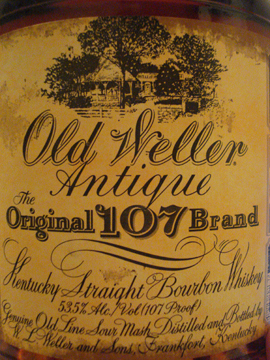
Old Weller Antique suffers from the all-too-common conception that bourbon, especially aged bourbon, needs to market itself as the product of the mid 19th century.  The faux-stained-parchment label, old-timey script, and wood-pattern upper label are all surefire signs of lazy design – if not total positioning strategy.  The appearance does not manage the charming awkwardness of Old Grand-Dad, nor does it attempt the craft-distiller look of Willett’s.

The elements of the presentation that I do enjoy are their measurement of age in summers on the label, and the shape of the bottle itself.  The bottle manages to be distinct and un-showy at the same time and eschews the increasingly common wooden-doorknob style cork for the unpretentious plastic screw-top.

Tasting:

Though Old Weller Antique is a hefty 107 proof, you couldn’t tell by its aroma.  Where some bourbons come out punching, sopping in alcohol, OWA is more subtle to the nose.  The aroma is constructed mostly of dried hay, oak, and warm, wet asphalt.  There’s also a slow sweetness to the whole thing that is not overly apparent.

OWA’s wheat pops up when it first hits the tongue, but doesn’t last too much longer.  The wheat-sweet is immediately overwhelmed by a dominant spiciness that defines the drink.  The spice lasts quite some time, but slowly fades into a nutty finish.  Amid the spice though, you can sense its time in the wood and a bit of fruit hidden away.

Over all:

Despite the lazy presentation, Old Weller Antique is actually quite a good drink.  I must admit to not liking it all that much after the first sip, but the lingering of the nutty spice and the flavors that reveal themselves as you spend more time with the drink are really quite nice.

This is definitely a bourbon to spend some time with.

Willett Single Barrel

This was the second of the two recommendations from LeNell’s last week: Willett’s single barrel expression.  According to what I was told at the shop, this is one of the first releases from the Willett distillery in a number of years.  That combined with the really interesting bottle shape are what drew me to this selection.

Presentation:

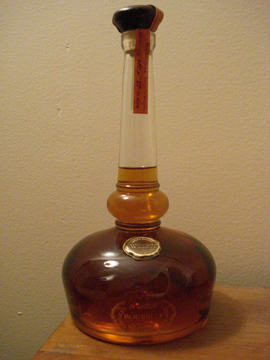
The first thing anyone will notice about the Willett Single Barrel Estate Reserve is the bottle, which seems to be shaped like one of their stills: a long, slender neck, a squat base, and a bulge between the two.  On the bottle is some spidery, gold lettering going on with the usual bourbon-fluff of craftsmanship, selectiveness, etc.  Thankfully this copy is barely readable so the focus remains on the bottle shape and the actually hand-labeled seal over the cork (mine is bottle 29 of 260 from barrel number 9706).

It’s difficult to find much information about this release online.  It seems all information about Willett online is woefully out of date by at least 5-8 years.  I suppose this backs up what I was told at LeNell’s – this is really a brand that has been quiet for some time.

Tasting:

To the nose, Willett’s is much more alcoholic than it truly is.  This 94 proofer comes across like a 100+.  Beyond that there are notes of honey, butterscotch, and some char – a very sweet impression.

Upon drinking however, I was quite surprised.  Willett’s develops in a way that I’ve never really experienced before, almost backwards.  It begins smooth and creamy, then bursts onto the back of the tongue with a sweet tartness before fading into a long, lingering, oaky finish.  Most bourbons have their burst in the beginning, whereas Willett’s delays for a bit longer.  The initial sensations are a mild butterscotch and char, but very smooth.  Next comes the burst of tart citrus and cherry-flavored candy in the back of the mouth.

Over all:

A very interesting bourbon.  It is not the most complex, but Willett’s manages to distinguish itself from the crows well.  I hope to see more releases from them like this one.

Wild Turkey Rare Breed

Wild Turkey’s Rare Breed came to me recommended by the good folks at LeNell’s down in Red Hook.  I told them that I was looking for something more in the vein of Knob Creek and Booker’s than Four Roses Small Batch or Old Grand-Dad, something with more depth.  After reviewing a few options, I settled on Rare Breed since I’ve yet to write about a Wild Turkey product on the blog.

I’m particularly looking forward to tasting how the barrel-strength nature of WTRB influences its character.  The fact that this barrel proof expression is a mere 108.2 proof speaks to the low proof distillation.

Presentation:

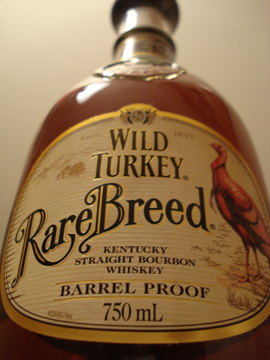
Rare Breed comes in a short, wide bottle with a short neck, one that is quite different from the rest of the bottles in my collection.  The shape manages to communicate the idea that this is a premium product, yet it does so in an understated manner, without Booker’s heavily waxed wine bottle, or Four Roses Small Batch’s inward-sloping cut.

The labeling and text are rather simple, they highlight the fact that Rare Breed is barrel proof but little more.  The small pamphlet that comes attached to the bottle invites the buyer to join the “Rare Breed Society” which, while clearly a direct marketing pitch, still manages to be somewhat effective in convincing the buyer that he is somehow distinguished in his purchase.

Tasting:

To the nose, WTRB at first gives an impression of rubbing alcohol, but after backing up a bit notes of hay, corn, red berries, and toffee develop.  One of the more impressive characteristics is the color which is a rich reddish-amber, perhaps this is a result of not having to cut it with water, but whatever the reason this is a fine-looking bourbon.

On the palate, the red berry sensation reappears right off the bat, followed by a familiar corn and caramel body, finally there is strong note of black peppercorn.  The finish is very clean and the drink itself quite smooth, which was a bit of a surprise.

Over all:

I was expecting something intense and raw, yet I found a drink of interesting flavors, but managed to remain quite smooth.  There wasn’t the depth I was hoping for either, especially from a barrel proof expression.  WTRB is a quite good bourbon, with a good balance of character and smoothness, but don’t reach for it expecting something to ponder over for a while.   I’d say this is a drink best suited for cold winter nights.

Old Grand-Dad, Bonded

After last week’s extravagance in the form of Booker’s, I’m toning things down this week with a bottle of Old Grand-Dad.

Presentation:

OGD is an interesting case and charming in its peculiar qualities – or lack thereof.  The first thing one notices when looking at a bottle of OGD is the jarringly orange label with green and gold type.  Perhaps it’s meant to blend with the orange-hued spirit, perhaps there is some long held brand tradition, or perhaps it’s the simple fact that it’s a hell of a lot easier to pick out an orange label among the almost uniformly earth-toned bourbon shelf.

There are a few elements of the OGD packaging that distinguish it beyond the color scheme.  First to note is the fact that the company makes sure their drinker knows that this is a bonded whiskey.  While this is surely not the only bottled-in-bond variety of bourbon available, OGD seems to be the proudest of this point.  For a bourbon to be “bottled in bond” it means that the whiskey must be the product of one distillation season, one distiller, and one distillery, while being sold at 100 proof and having aged at least four years.

OGD’s proclamation of their bonded status makes sense when looking at the other details of the bottle.  At the bottom of the label is the sentence, “Bottled in bond under supervision of U.S. gov’t,” and surrounding the central portrait (presumably of Basil Hayden?) are the words “Registered U.S. Pat. Off.”  Both these details are oddly prominent on a modern bourbon bottle – and very likely not necessary, despite their official tone.  Instead, they likely are placed as they are to hark back to an age when they were necessary to verify the authenticity of the product.

It is this type of bureaucratic nostalgia, combined with the garish orange, which gives OGD its awkward charm.

Tasting:

Old Grand-Dad is nothing if not straight-forward, through and through.  To the nose it is quite medicinal with notes of oak and vanilla.  You can tell that this is 100 proof right away.

On the palate OGD is simply a classic bourbon: corn sweetness, caramel, and oak are the dominant sensations with a lingering finish of charred oak.  It’s tough to find too many more ways to describe it, but that seems to be the point of OGD, it is simply bourbon as it should be – no frills but no cut corners.

Over all:

At $18/bottle, Old Grand-Dad is a good choice for an every-day bourbon.  You can certainly do better than it, but there’s definitely a lot worse out there and probably for more dough.