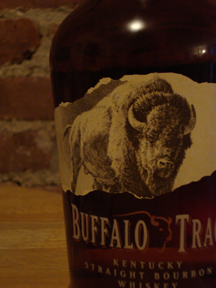
 I chose Buffalo Trace as the inaugural spirit for this blog on the recommendation of one of the employees at LeNell’s, here in Brooklyn. It was described to me as a no-nonsense, and relatively muscular burbon, but after tasting it, the picture turned out to be a bit more complicated.
Presentation:
Buffalo Trace relies heavily on a sense of American national nostalgia to sell its product. From the faux-ripped label, to the back label’s tedious reliance on adjectives such as “bold,” “mighty,” “pioneering,” “tradition,” handcrafted,” and “confident,” this is not a marketing strategy that sees fit to engage in subtlety. The buyer is supposed to imagine himself (it is not geared toward the feminine) as returning to a hardier, purer time when the art of crafting liquor was imperfect yet honored, there were buffalo in Kentucky, and bold men made mighty spirits.
I’m a sucker for nostalgia as much as the next guy, but c’mon BT, ease up a bit.
Tasting:
Upon first opening the bottle there was an immediate wave of vanilla – sweet and clean. An interesting way for such a “mighty” drink to begin.
When drinking, the first bits of character I noticed were a sweetness, wet earth, and what could only be called meaty oak. There was plenty of substance to it, but a much gentler introduction than I had expected.
The finish was surprisingly clean but with a bit of a lingering sensation of post-rain spring air, a bit of char, and an almost-floral quality. I was not expecting that in the least. Add a little water and the almost-floral character becomes dominant.
Thoughts:
I was really surprised by this bourbon. I was expecting a rough-and-tumble whiskey with a healthy whack of (perhaps complex) flavor. In fact, it was far more subtle and gentle, presenting an earthier and friendlier over all character.
I wouldn’t say that Buffalo Trace is lacking in strength, rather it surprised me in the depth it displayed beyond the traditional bourbon character.
The presentation and marketing irks me a little, playing into the idea that whiskies must represent the past to vodka’s future. Ultimately, the marketing material on the bottle serves mostly to corner the drink into a limiting category of national nostalgia when in fact it seems to be eschewing older definitions of bourbon and looking toward new possibilities – as evidenced by the apparent critical acclaim.
This was a good whiskey to begin this blog.
 American Hooch