Tag Archives: Bourbon

Old Grand-Dad, Bonded

After last week’s extravagance in the form of Booker’s, I’m toning things down this week with a bottle of Old Grand-Dad.

Presentation:

OGD is an interesting case and charming in its peculiar qualities – or lack thereof.  The first thing one notices when looking at a bottle of OGD is the jarringly orange label with green and gold type.  Perhaps it’s meant to blend with the orange-hued spirit, perhaps there is some long held brand tradition, or perhaps it’s the simple fact that it’s a hell of a lot easier to pick out an orange label among the almost uniformly earth-toned bourbon shelf.

There are a few elements of the OGD packaging that distinguish it beyond the color scheme.  First to note is the fact that the company makes sure their drinker knows that this is a bonded whiskey.  While this is surely not the only bottled-in-bond variety of bourbon available, OGD seems to be the proudest of this point.  For a bourbon to be “bottled in bond” it means that the whiskey must be the product of one distillation season, one distiller, and one distillery, while being sold at 100 proof and having aged at least four years.

OGD’s proclamation of their bonded status makes sense when looking at the other details of the bottle.  At the bottom of the label is the sentence, “Bottled in bond under supervision of U.S. gov’t,” and surrounding the central portrait (presumably of Basil Hayden?) are the words “Registered U.S. Pat. Off.”  Both these details are oddly prominent on a modern bourbon bottle – and very likely not necessary, despite their official tone.  Instead, they likely are placed as they are to hark back to an age when they were necessary to verify the authenticity of the product.

It is this type of bureaucratic nostalgia, combined with the garish orange, which gives OGD its awkward charm.

Tasting:

Old Grand-Dad is nothing if not straight-forward, through and through.  To the nose it is quite medicinal with notes of oak and vanilla.  You can tell that this is 100 proof right away.

On the palate OGD is simply a classic bourbon: corn sweetness, caramel, and oak are the dominant sensations with a lingering finish of charred oak.  It’s tough to find too many more ways to describe it, but that seems to be the point of OGD, it is simply bourbon as it should be – no frills but no cut corners.

Over all:

At $18/bottle, Old Grand-Dad is a good choice for an every-day bourbon.  You can certainly do better than it, but there’s definitely a lot worse out there and probably for more dough.
Booker’s

I went all-out with this week’s selection and tried Booker’s, which sits atop Jim Beam’s small batch bourbon series.  I quite enjoyed Knob Creek and was pleased with Jim Beam Black, so I figured I’d see what the best they have to offer is like.

Presentation:

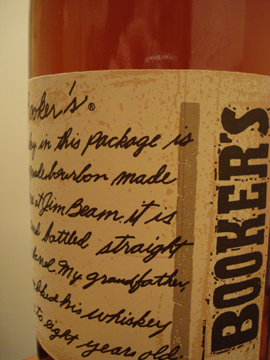
To signify (or justify) the higher price tag and quality, Booker’s comes in a wine bottle.  Whether this is due to some naturally more graceful form or merely the association with the beverage of a pricier heritage, I’m not sure.  The top of the bottle is encased in black wax, covering a raised and tasseled ‘B’ at the base of the neck – a tasteful effect over all.

The marketing copy is short yet prominent.  The label is faux hand-written – one is to presume this is the posthumous hand of the titular Booker Noe himself.  Looks nice, but either hand label your bottles or don’t, splitting the difference just makes me think I’m not getting what you want me to think I’m paying for.

Additionally, there is a smaller label higher on the bottle with a specific age and proof statement (5 years, 5 months, 126.8 proof in my bottle’s case).  Seeing as this is a single-barrel expression, I’m fairly sure that this changes from bottle to bottle.

Despite my complaining about the fake hand-writing and wine associations, Booker’s does come across as appealingly simple over all.
Tasting:

To the nose, I could hardly tell that Booker’s was 126+ proof.  The nose was quite subtle and complex.  Mainly it was sweet in a molasses and maple sort of way, yet there were also intriguing elements of oak, vanilla, and buttercream.  Very appealing.

If I thought that Booker’s was easy on the nose, it was saving the full wallop of its proof for the palate.  It was very difficult to discern much of any flavor in the first sip as a result of the overwhelming alcohol.  The second sip revealed a bit more of what was behind the curtain, but it wasn’t until I added some water (which I rarely do) that the full flavor of Booker’s came through.

In it are notes of fresh baked bread, burnt sugar, the familiar Beam sweetness, buttercream and oak.  The finish begins spicy and fades into a grassy freshness.

Over all:

Booker’s is a very good bourbon.  There are flavors in it that I have never tasted in a bourbon before (buttercream mostly) that were a pleasant surprise.  I’m definitely glad that I own a bottle to bring out on special occasions, but ultimately the price tag makes this a prohibitive purchase for anyone who isn’t serious about their drink.

Jim Beam Black

Surely, one of the first bourbons I ever tasted was Jim Beam – probably the white label variety and probably with more attention paid to the effects of the drink than its characteristics, sadly.  This is a classic brand that has maintained its status as the standard for Kentucky bourbon for many years.  As a result, it’s difficult to look at a bottle of Jim Beam Black with a fresh and critical set of eyes.

Presentation:

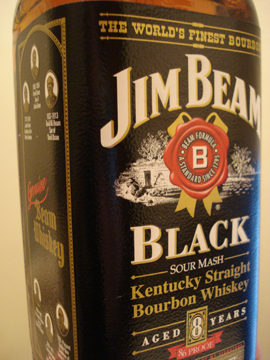
JBB is aged 8 years – twice that of the white label and one year short of Beam’s Knob Creek.  The packaging strays little from the design of the mainline variety, sporting the familiar signature, family tree, red seal, and typeface.  The marketing copy on the side is relatively understated in both its description of the product as well as in the coy humility inserted at the end: “…we know a little about making exceptional bourbon.”

All in all, the packaging is what you expect from Jim Beam, it is one of the standards against which other whiskeys judge their appearance.  The grabs at nostalgia here seem more genuine than fetish-object: the signature at the bottom was introduced decades ago as a hedge against trademark infringement (forgery carrying a higher penalty than the infringement itself).

What can one really say about this bottle?

Tasting:

There is nothing overpowering in the nose of Jim Beam Black, nor is there anything overly complex.  Notes of floral sweetness, oak, and fruit present themselves and quietly retreat.

On the palate Black is much more assertive.  Immediately the corn-driven sweetness is prominent at first, followed by something akin to berries, fresh legumes, and char.  The finish is largely clean with a hint of lingering spice.

Over all:

The similarity between Jim Beam Black and Knob Creek is certainly clear, yet it seems that Knob Creek’s extra year in the barrel made significant difference in the product.  Black is punchier than Four Roses, more interesting than Bulleit, but falls short of Knob Creek in terms of depth and complexity.  Regardless, with the lower price, this would be a good buy.

Knob Creek

After last week’s screed against nostalgia-based marketing, I chose a bourbon that relies less on grandfather-distillers of yore and focuses more on stuff their grandchildren are making today.

Presentation:

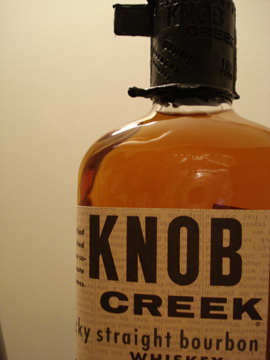
Knob Creek’s marketing material on the bottle is refreshingly contemporary, while not completely eschewing references to less mechanized times. They use sans-serif fonts, irregular angles, and intersecting text while making nod to the past with the wax-sealed top and the singular serrated label edge. The bottle text does not speak of ancient recipes or generations old practices, rather it focus on the care that goes into the product itself: 9-year aging, small batch, straight bourbon.

The one deceiving element, however, is the fact that this presentation would have you believe that Knob Creek is a small-time craft distiller, when in fact it’s an arm of Jim Beam and created on the same stills with similar methods.

Tasting:

Opening the bottle releases a sweet whiff of post-rain freshness, but the real fireworks start after it’s poured. The nose definitely tells you this is an assertive drink – definitely 100 proof: warm, wet asphalt, oak, hard candy.

Knob Creek is even less subtle on the palate. It comes in swinging with sweetness and and almost-citrusy tartness. This is followed by a fruity, meaty depth you can sink your teeth into. It finishes long and slow with spice mellowing into a lingering oak.

Over all:

This is a very assertive drink and equally enjoyable. The extra few years in the barrel seem to have done a lot of good. Knob Creek is perhaps the first bourbon I’ve tasted in the course of this blog that could go head-to-head with many single malt scotches as far as complexity and meatiness go.

Definitely my favorite so far.

American Whiskey’s Nostalgia Fetish (and Bulleit Bourbon)

The American whiskey industry’s fetish for nostalgia marketing: it baffles me. It really does. It’s not as if Scottish whisky is branded too differently, but American brands have gone to great lengths to manufacture a – largely imagined – distilling past that involves rugged mountain men hewing a nation out of raw nature.

Sure, it’s romantic, and I’m just as susceptible to these narratives as the next guy, but ultimately this strikes me as a destructive practice. We are in the midst of an unprecedented moment: an explosion of variety, techniques, and interest combined with competitive pricing in comparison to Scottish product and a market hungry for innovation. In my mind, brands should be highlighting characteristics that feed this unique postion for American whiskey.

Look at Old Potrero and Buffalo Trace. Both are active in driving American liquor production to new territory, actively tweaking and expanding upon tradition to create exciting, new offerings. Yet, at the same time, both brands’ flagship products are painted with a thickly nostalgic brush. They should be coming out and trumpeting their innovation to the broader market, rather than the Malt Advocate crowd alone.

This leads me to this week’s tasting: Bulleit Bourbon.

Presentation:

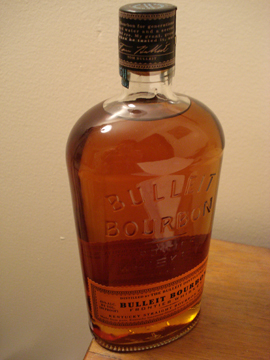
At first glance, Bulleit leans heavily on nostalgia. From the serrated label, to the blocky font, to the medicine-flask bottle, they would have you believe that they dug this out of old Augustine Bulleit’s grave. In fact, none of the copy on the bottle speaks to what the product inside might be like – it is entirely devoted to convincing the consumer that this whiskey has a long history and has never changed.

The most telling indication of the nostalgic reliance is in the labeling of the product as “frontier whiskey” – as if this bottle was produced in the days of nascent American whiskey production.

Tasting:

Upon first opening the bottle is a gentle, sweet nose with a not-insignificant corn presence. Goes with their “frontier whiskey” claim, certainly.

The full nose is not too different from the initial impression: sweetness, corn, some latex. I was a little surprised by the lack of charcoal and post-rain freshness to it.

Upon drinking, Bulleit is largely unassuming. It begins and ends quietly, with a clean sweetness throughout. There is less corn on the tongue than in the nose and there is a noticeable flash of not-altogether unappealing must in the middle.

Over all:

This is certainly drinkable, but all in all is a little boring.

Clearly, Bulleit has focused all effort on making their product fit into the correct nostalgic category. They would be better served focusing on what they fill the bottle with, rather than what misleading narratives they print on it.

Four Roses – Small Batch

The bottle of Four Roses Small Batch was sold to me to contrast the Buffalo Trace I was purchasing at the same time. Supposedly the Four Roses would play the good cop to Buffalo Trace’s intense and bold bad cop.

Presentation:

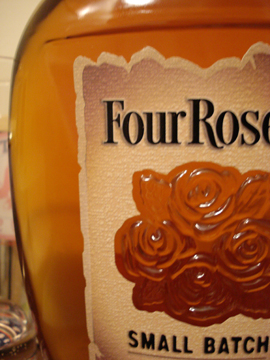
Without even opening either bottle it’s pretty clear that Four Roses has something like this in mind. Small Batch comes in a distinctively feminine bottle (in shape) compared to Buffalo Trace’s prominent phallus – a bottle one would sooner expect of cognac than bourbon. This dissonance in comparison with other bourbons’ presentation is underscored by the wide-mouthed cork and raised-glass roses at the center of the face.

Overall, the presentation is quite attractive and succeeds in presenting the product as something deserving of both savor and a higher price tag. It pushes the drink away from a Buffalo Trace-style of Americana to an Americana more genteel and refined, and perhaps toward those who might otherwise shy away from bourbon.

There is at least one nod toward the manly-bourbon style: the faux-aged label that surrounds the raised-glass roses. What is it with bourbon that requires a faux-aged label? For all that Four Roses does with Small Batch to differentiate it, this is one irksome backtrack.

Tasting:

Upon opening a new bottle, the aromas take some time to sneak out as opposed to leaping from the mouth to our nose as a Talisker or Buffalo Trace might. When poured, the aromas manage to be both gentle and rich somehow. There is certainly a sweetness reminiscent of fruit juices and vanilla, but there’s also something resembling a distant barbecue on a summer evening. It wasn’t the easiest combination of scents to pin down, yet at the same time it has a steady presence to it.

On tasting, the sweetness certainly hits you first – the fruitiness and almost-citrus. Immediately after is a slight spiciness. These flavors are not intense but are self-assured. There’s very little wavering leading up to the very clean finish.

This would be a great bourbon to give to folks who have only experienced the Jack Daniels and Jim Beam end of things. Four Roses Small Batch is an interesting case. Simple, yet with enough depth to satisfy.

Buffalo Trace Kentucky Straight Bourbon Whiskey

buffalo traceI chose Buffalo Trace as the inaugural spirit for this blog on the recommendation of one of the employees at LeNell’s, here in Brooklyn. It was described to me as a no-nonsense, and relatively muscular burbon, but after tasting it, the picture turned out to be a bit more complicated.

Presentation:

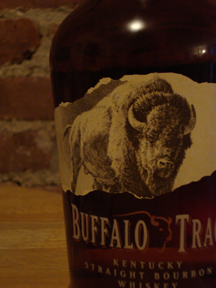
Buffalo Trace relies heavily on a sense of American national nostalgia to sell its product. From the faux-ripped label, to the back label’s tedious reliance on adjectives such as “bold,” “mighty,” “pioneering,” “tradition,” handcrafted,” and “confident,” this is not a marketing strategy that sees fit to engage in subtlety. The buyer is supposed to imagine himself (it is not geared toward the feminine) as returning to a hardier, purer time when the art of crafting liquor was imperfect yet honored, there were buffalo in Kentucky, and bold men made mighty spirits.

I’m a sucker for nostalgia as much as the next guy, but c’mon BT, ease up a bit.

Tasting:

Upon first opening the bottle there was an immediate wave of vanilla – sweet and clean. An interesting way for such a “mighty” drink to begin.

When drinking, the first bits of character I noticed were a sweetness, wet earth, and what could only be called meaty oak. There was plenty of substance to it, but a much gentler introduction than I had expected.

The finish was surprisingly clean but with a bit of a lingering sensation of post-rain spring air, a bit of char, and an almost-floral quality. I was not expecting that in the least. Add a little water and the almost-floral character becomes dominant.

Thoughts:

I was really surprised by this bourbon. I was expecting a rough-and-tumble whiskey with a healthy whack of (perhaps complex) flavor. In fact, it was far more subtle and gentle, presenting an earthier and friendlier over all character.

I wouldn’t say that Buffalo Trace is lacking in strength, rather it surprised me in the depth it displayed beyond the traditional bourbon character.

The presentation and marketing irks me a little, playing into the idea that whiskies must represent the past to vodka’s future. Ultimately, the marketing material on the bottle serves mostly to corner the drink into a limiting category of national nostalgia when in fact it seems to be eschewing older definitions of bourbon and looking toward new possibilities – as evidenced by the apparent critical acclaim.

This was a good whiskey to begin this blog.