Category Archives: Bourbon

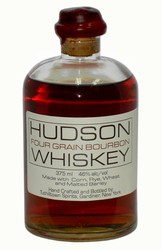
Hudson Four Grain Bourbon Whiskey

fgbI met Ralph Erenzo – co-founder of Tuthilltown Spirits – at a tasting at Fermented Grapes this weekend. I’ve tasted TS’s barley Single Malt before and I’ve been curious about their Four Grain Bourbon more or less since.  So, after tasting some of TS’s apple vodka and Baby Bourbon (as well as a pleasant conversation with Ralph) I took home a bottle.
Stats:

– $35-40
– 92 proof
– Made by Tuthilltown Spirits

Presentation:

As I’m sure I wrote before with the Single Malt, Tuthilltown Spirits squat little bottle with wax-dipped top is attractive for its lack of affect and medicine-bottle look, while avoiding the kitch and nostalgia of other American whiskies.  My only complaint is the wordiness of the paragraph on the back, which belies the rest of the packaging’s simplicity.

Tasting:
On the nose FGB is very muted.  There’s a bit of spicy, pepperiness from the rye as well as a sweet maple syrup scent.

The first sip enters smoothly and sweet, then develops a full-mouth grainy, grassy taste.  It’s here where it reveals some youth though (it’s aged less than a year in small barrels) and a little tartness, but it slowly moves into a medium-length peppery finish.

Over all:
Tuthilltown’s Four Grain Bourbon is pleasantly full.  If I didn’t know it had been aged less than a year (Mr. Erenzo let that out) I probably wouldn’t have been able to guess.  I’m looking forward to what they produce in the future.

Baker’s (mini-bottle)

bakersMy little brother was thoughtful enough to give me a sampler for Jim Beam’s Small Batch Bourbon Collection over the holidays, so I saw this as a perfect time to complete my reviews of this line by tasting Baker’s.  (You can find the other’s here: Knob Creek, Basil Hayden, Booker’s)
What does it mean that I’m reviewing something in its mini-bottle form?  Honestly, I’m not too certain either.  Sure, this didn’t make it into the full-bottle batch and this can’t be experienced in the same way that the full bottle could; on the other hand, its the same stuff inside and it seems that Beam has taken great care with the miniature versions of their Small Batch Collection.

Stats:

– Probably a few dollars by itself

– Made by the folks a Jim Beam

– 107 proof

Presentation:

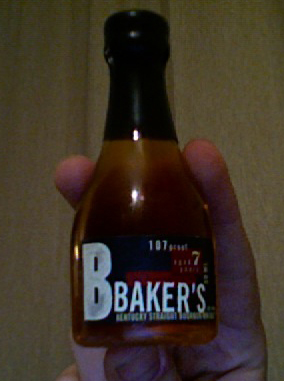
While it’s difficult to judge a bourbon’s bottling when in mini-bottle form, the small batch collection minis do seem to hold largely true to their bigger-bottle form.  Knob Creek mini has its distinctive angular form and Basil Hayden mini has its tall, distinguished proportions.  Baker’s and Booker’s bottles are given a tear-drop form that is only mildly reminiscent of their actual shape, but represent a valiant effort in miniaturization, regardless.

I do remember liking the Baker’s distinctive capital B and use of type during visits to the bar and the mini-bottle uses this same motif to only slightly more confusing effect (the capital ‘B’ is right next to the ‘B’ in “Baker’s” making it look like “BBaker’s”.)

Lines and fills are ever so slightly rough and overly bold in order to mimic an old letter press and come in varying typefaces.  One edge of the label is serrated while the others are smooth.  All in all, this comes across as the older brother of Knob Creek.  Not afraid to stray from the yarns of long-dead grandfathers that adorn other bourbons, but not dispatching with a sense of history over all.

Tasting:

Very upfront nose.  Citrus, grass, roasted almond, fresh cherry.  There is very little subtlety about this aroma, but it is pleasant and un-astringent for a 100+ proofer.

On tasting it’s sweet, with some notes of oats and citrus, finishing with a nice lingering warmth and some tanginess, this settles into a vanilla-and-smoke after a while.

Over all:

Baker’s is not shy.  It is bright for the most part and settles into something a little more subdued over time.  I actually like this one quite a bit – and it may even be my favorite of the small batch collection from Beam.  That said, it also is the one that reminds me the most of Jim Beam black – and that’s not a bad thing in my book.

I’ll have to pick up a full-sized edition when I get a chance.

Jefferson’s Reserve

jeffersonsreserveJefferson’s Reserve is one of the three “Very Small Batch” offerings from McLain & Kyne (of Castle Brands).  It seems that by “Very Small Batch” they mean it’s the product of only eight to twelve barrels, but this is the only time I’ve seen the term used with the “very” modifier.
From what I’ve been able to glean from a few minuted of research, JR is (or was originally) produced at the same place as Willett’s, nearby Heaven Hill.  The pricing and name-checking of a particularly gentlemanly President demonstrate the producers’ intentions of placing this bourbon firmly in the super-premium category.

Stats:

– $45-55

– Made by McLain & Kyne

– 90.2 proof

Presentation:

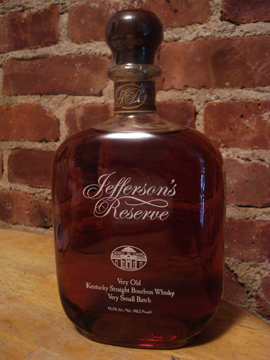
Jefferson’s Reserve comes in a very simple, refined bottle, marked by its lack of a front or back paper label.  The front sports the brand name in a flowing script intended to mark the distinguished nature of the bourbon within and perhaps to conjure the former President’s spirit.  Below this is a small image of Monticello, again recalling Jefferson’s grand style of living to which we might aspire.  The only other text on the bottle is “Very Old / Kentucky Straight Bourbon Whisky / Very Small Batch.”

First of all note the use of “Very” to modify both “Old” and “Small” – as I mentioned earlier, “Very Small Batch” might be a brand-associative term for McLain & Kyne, but also applying it to “Old” just seem gauche in a way which Jefferson himself would never approve.  It also seems that Jefferson’s Reserve once did have a distinct age statement (15 years), but they’ve ditched that in recent years.  Likely they’re using barrels from a number of different year now to meet the flavor profile, but the average age is likely not far from 15 I would guess.

Secondly, note that they use “Whisky” instead of the more common spelling (for bourbon) “Whiskey”.  This seems to be another distinguishing mark meant to connect the bourbon to an older tradition than its competitors.  A subtle move; or as McL. & K. might put it, Very Subtle.

Tasting:

Jefferson’s Reserve has a quiet, but pleasant aroma to it.  I was able to pick out strains of raisins and dried summer grass.  This is not something that will jump out at you as soon as you open the bottle, but it comes in time.

On the palate, JR is equally quiet.  Starting with unsweet sensations of vanilla and grass, these quickly dissipate into a very clean finish, but not before a quick, sharp spark of tobacco comes and goes.

I’m surprised not to be tasting more wood, considering how old this is supposed to be.  That’s a commendable trait – often it seems that in a rush to compete with scotch, bourbons are over-aged and become too woody.

Over all:

If you’re looking for depth of flavor and complexity, Jefferson’s reserve is not for you.  If you’re looking for subtle flavors and the air of something Very Refined, have a go at it.  For this price point, make sure you’ve had a number of other bourbons first, however.  I think there are a few other options lower on the price scale that would fit into a similar tasting category.

Van Winkle Special Reserve

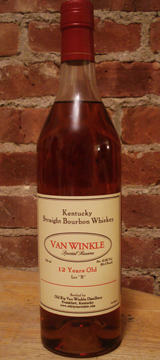
vanwinklesrNow that 2009 is in full swing I’m going to start breaking open the couple of bottles I received during the holiday season from thoughtful friends and family.  One of the benefits of writing a blog about American whiskey is that it creates and easy gift category that will never fail to disappoint.
It’s in this spirit that I come to my first selection from the Van Winkle line of bourbons – Van Winkle Special Reserve.  Famed for their 23-year old Pappy Van Winkle bottling, Old Rip has seven main-line varieties in all, with VWSR falling right in the middle of the range (also the only one with out the words “Pappy” or “Old” in the name).

Stats:

$35-45

– Old Rip Van Winkle Distillery

– 90.4 proof

Presentation:

Van Winkle Special Reserve comes in a tall, slim bottle capped with red foil which leaves plenty of glass-room for the onlooker to admire the contents within.  This is by far the simplest labeling of the Van Winkle clan, decorated only by thin lines of black around the edge and a single red line toward the bottom.  The slightly textured paper is printed only with the basic information about the beverage: what it is, its name, its age, and its distiller.  The only seemingly extraneous information is the “Lot ‘B'” beneath the age statement.

One interesting thing to note is the special placement of the word “Kentucky” – appearing prominently above the words it modifies, “Straight Bourbon Whiskey” at the top of the label.  A quiet pride showing through the otherwise poised and gentlemanly presentation.

Thankfully, no back label beyond the government warning.

Tasting:

Van Winkle Special Reserve has a very pleasant nose.  What came to mind immediately was grenadine and dried leaves.  Certainly sweet, but impressively deep.

On the tongue VWSR is just as sweet at first, hitting the tip of the tongue with gusto.  This sensation fills out into cherries, popcorn, and some significant wood before melting in to a full-mouth slow-burning spice of a finish.  This is something to savor and draw out for as long as you can.

Over all:

This bourbon has a holistic feel to it that many others do not.  It’s hard to pull out individual bits and pieces from the entire experience.  At 90 proof, it strikes the right balance between heft and drinkability, but nothing has been sacrificed when it comes to complexity.  Nicely done.

Makes you wonder what they keep in Lot A…

Old Crow

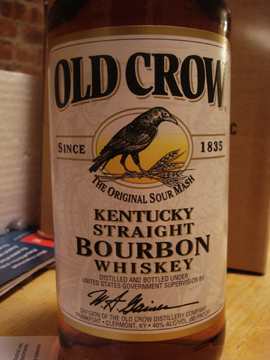
oldcrowYou can’t know a good top-shelf whiskey until you’ve had a few of the bottles on the bottom.  Shelf-height and price do not always properly denote quality so tasting a range will not only show you what a bad whiskey can be, but also help you discover a few gems.
It was in this spirit that I picked up a bottle of Old Crow.  Sure, I have my preconceptions about this brand – what with its many cultural references from bands I like to prominent American historical figures – which just means that I would have to approach this tasting with that much care.

But how can you talk about Old Crow without a bit of history creeping in?  After all, it gets its name from the man who invented the sour mash process (basically this is putting some of the old batch into the new) that all bourbons use to keep bottlings consistent over time.  Yet the bourbon before me today is probably quite different from the one Dr. Crow produced.

Stats:

– $10-15

– Old Crow Distillery Co. (Fortune)

– 80 proof

Presentation:

I like a bottle that isn’t overbearing – either in its modernity or its nostalgia – and Old Crow seems to cut a path down the middle.  On the one hand, there are a number of cues to tip the potential customer off to its history: the drawing of men transporting a barrel faded in the background, the “Since 1835” heading, and the very name itself.  On the other hand though, the designers made a clear effort to avoid the clutter that so plagues many bourbon bottles.

To top it off the historicizing text on the back is short and to the point: Dr. Crow invented the sour mash process, this bourbon is his legacy.  OC get points for its brevity, but not for the three-year age statement.

Tasting:

Sadly, Old Crow is anything but well-balanced when it comes to the nose.  It’s hard to move past the strong rubbing alcohol scent, and if you do there’s little to greet you but maybe a hint of corn-juice and char.  This is the first sign that we’re dealing with a bourbon that has been aged so relatively few years.

On the palate OC’s youth is expressed even further.  It is quick to come and quick to go and you’ll be lucky to catch something in between.  While not as harsh as I’d been expecting, it took a bit to tease out what little notable elements I could: a soft-caramel body and perhaps some woodiness, surrounded by the fresh-green corn.  This isn’t too far from Georgia Moon when compared with many other selections on this site.

The finish is quite clean and it is pretty smooth, all things considered.

Over all:

This is more or less what you’d expect from a young whiskey.  Some people like it this way, but there just isn’t enough heft or intricacy to hold my interest.

Ultimately Old Crow is disappointingly bland, a bit of a let-down, but not assertively unpleasant.

The American Hooch 2008 Gift Guide

I’ve gotten questions from many friends and co-workers about what bourbon they should buy for their friend/boyfriend/roommate for the holiday season.  This is always a difficult thing to judge since some of the best wiskies don’t always make for the classiest gift, but on the other hand many of the gift-like bottles aren’t the most original or demonstrative of taste.

With that in mind, here’s my American Hooch 2008 Gift Guide to help you navigate your social relationships with a properly chosen bottle of alcohol.

The Mantle Piece Bourbon

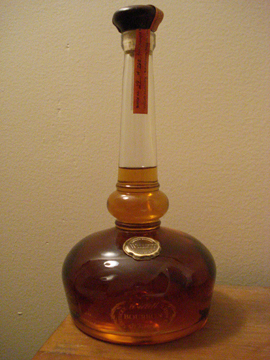
willettThis one is for that someone on your list who wants something to show off to folks stopping by over the holidays.  Willett Family Pot Still Reserve is certainly a fine tasting bourbon, with notes of butterscotch, cherry-sweetness, and honey, but it is most impressive in its profile.  Your receipient will not only be impressed with the pot still shaped bottle, but also the wonderfully gurgly noise it makes when you pour.  I wrote about it here.
This one might be a little tougher to find, but it will make an immediate visual impression.  It will also run you around $40.

Continue reading The American Hooch 2008 Gift Guide

Corner Creek Reserve Bourbon Whiskey

cornercreekThe other night I was on my way to my girlfriend’s apartment after work and decided to pick up a bottle of wine for dinner.  I stopped into fairly large (for Brooklyn) liquor store in her neighborhood and, of course, had to spend a bit of time in the bourbon/American whiskey section.
I didn’t intend to get any whiskies, but I picked up Corner Creek Reserve without much forethought.  It was in a reasonable price range and is not something that you see every day, so I figured I’d give it a try.  I left with it and an inexpensive bottle of wine.  You can see where my alcoholic priorities lie.

Stats:

$20-25

Made by Corner Creek

88 proof

Presentation:

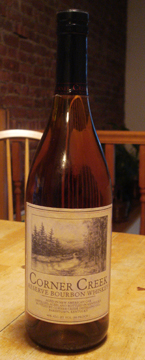
The thing that most people will notice about Corner Creek Reserve is that it comes in a green-tinted wine bottle.  That alone will make it stand out on most everyday liquor store bourbon shelves, but it also seems to be a part of a larger positioning play by the company, which I’ll get to in a moment.

The front label is dark blue ink on unbleached paper with a fine, red border line.  It is dominated by a print of what we must assume is the eponymous creek, below which is the name and basic aging and production information.  The font is a rustic serif set in a very matter-of-fact style, giving a sense of openness to the packaging that contrasts the cluttered nostalgia of many bourbon bottles.

The copy on the back tries to tie what Corner Creek is doing to the selection of fine wines: “In the tradition of the great wine importers, we … search for the the elusive few great barrels of prime aged American whiskey, and offer it to you in this limited bottling.”  This is a clever tactic, likely meant to draw in curious (and apparently snooty) oenophiles who might be put off by the usual peculiarities of bourbon packaging.

This is where CC’s product positioning becomes clear, they have created a bottle that looks and appeals to wine drinkers and noticably eschews the common bourbon tropes in favor of common wine tropes.  They’ve gone for classy rustic instead of the bourbon favorite trio of old men, old recipes, and old times.

Tasting:

Corner Creek Reserve does not have much of a nose to it.  It feels tight and pretty locked-up in comparison with its usually more bombastic bretheren.  You can search, but really all you’ll find is a bland sweetness with maybe a hint of ash.

Things open up a bit more on the palate.  I got pine, some distant smoke, along with the usual corn/caramel.  The finish is largely smooth but lingers a bit with a smooth creaminess.

One thing I can say about this over all is that it is very smooth.  It is more like Basil Hayden’s in this way, but without as much complexity.  Goes down easy despite the 88 proof.

Over all:

I have to hand it to Corner Creek, they’ve created the perfect bourbon to capture wine drinkers.  Everything from the presentation to the liquor itself seem tailor made to draw someone away from their cabernets and merlots.

It’s a good, smooth bourbon that won’t get you too excited, but which I’ll probably bring out for folks who like a milder drink or are nervous about leaving their oenophile ways.

American Honey

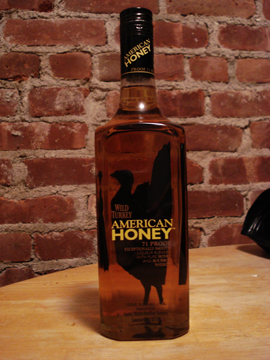
american_honeyI didn’t choose this week’s tasting for its nominal similarities to the blog, but I’d be lying if I said it was completely unrelated.  I first read about American Honey in Malt Advocate (I think?), but finally saw it in the corner liquor store a few days ago and decided to give it a try.

Last winter I started mixing honey with bourbon every now and then to great effect as a simple, enjoyable winter drink.  I’d imagine AH does a fine job coming from such inspiration, but I’m worried that it will stray too far from the simple mixture of its roots.

Stats:

– $20-25
– Made by Wild Turkey / Austin, Nichols
– 71 proof

Presentation:

The bottle is quite attractive: sleek, simple, and unadorned – yet it begins to approach the dangerous territory of chic vodkas.  The major visual element is a silhouetted turkey on the rear of the bottle.  Otherwise the design consisted of a clearly printed “American Honey” on the front along with a brief description.

Perhaps thankfully, a long-winded, tall-tale origin narrative isn’t expected of this product.

Tasting:

A careful whiff demonstrates that this is indeed bourbon – you can definitely smell the char and wet grass elements.  It is definitely much softer and and lighter as one would expect.

On tasting, it opens strongly with honey then moves more into its bourbon elements of oak and hay.  What takes me most off guard is the almost floral finish to it, odd.  This is most certainly different from the mixtures I’ve whipped up at home.

Over all:

I like this, but I’m not sure I’d buy it on a regular basis.  It doesn’t offer much beyond what you might get by adding a bit of simple syrup to your bourbon.  That said, there are some interesting qualities to it that go beyond a simple honey/bourbon concoction that might merit further exploration in the realm of cocktails.

Basil Hayden’s

basilhaydenBasil Hayden’s is the other of Jim Beam’s top-shelf selection, along with Booker’s and Knob Creek which I’ve written about before.  I’ve heard that BH is a lot smoother and gentler than those other two.  That could be a good or a bad things depending on who’s saying it and what the occasion is, though I have to admit I prefer a bolder drink so I’m a little wary.  On to the stats!

Stats:

  • $30-$40
  • 80 proof
  • Made by the Jim Beam folks

Presentation:

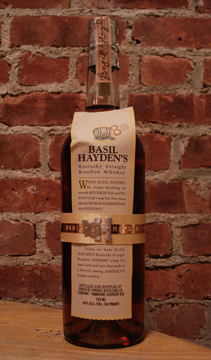
Certainly the bottle reflects Basil Hayden’s relative lighness to an extent.  Soft tones and carefully constructed curves contrast with Booker’s homemade feel and Knob’s bursting angularity.  The labeling is actually pretty interesting.  It consists of a smooth, brown paper tunic over the neck of the bottle and extending down the sides and belted by a band of wood and copper.

I like the consistent soft coloring and relatively minimal look, but the story about George Washington and the four-year-old state of Kentucky is a little schlocky.  I suppose anyone who’s read this blog before could have seen that coming.

Tasting:

Basil Hayden’s immediately lets off a sweet aroma once it is poured.  While strong, further inspection opens up tree bark and dry wheat, but remains powerfully candied all along.  Candied wheat?  Is that a thing?

On tasting, there is a quick hint of the explosiveness of Knob Creek, but it quickly fades into a strawberry mingled with a bit of spice.  Toward the end there’s a slow burn of something like dry corn followed by a very clean and easy finish.

One thing that did surprise me here was the mouth feel – it was much bigger than I’d expect from the lighter end of the Beam small-batchers.

Over all:

Basil Hayden’s was very pleasant.  Just now I’ve poured myself another tasting, in fact.  But ultimately it’s nothing to get excited about.

It would make an excellent introductory bourbon for the uninitiated or those used to lighter fare, but only if it weren’t so pricey.  This will be nice to have around and contrast with some of the rest of my collection, but isn’t my favorite of its immediate family.

Old Fitzgerald 1849

My apologies.  It’s been a few weeks since I’ve been able to get around to blogging here.  The first delay was on account of going to a Bulleit tasting at the Brandy Library (it got a little rowdy for the BL) and the second delay was from me being off in Germany last week where bourbon is not a priority for the locals.

Now that I’m back, I’ll try instituting a new section to the regular posts, a “Stats” section which will list price range, proof, and maker – thanks for the idea, Dave!

First up on my return: Old Fitzgerald 1849.  On my last trip to Lenell’s, I specifically asked for something from the lower end of the price-scale.  Both my wallet and my instincts were telling me that I’d been focusing a bit too heavily on $30+ bottles and it was time to look a little lower.  I’d had good experience with the Old Grand-Dad Bonded, so surely there were other gems among this, the everyman’s liquor.  I think it was Ingrid there who recommended OF1849.

Before tasting, I did some quick internet-research and found that you can’t go very far without coming across accolades for OF1849 as a bourbon with a high quality-to-price ratio.  These are high stakes that were set up for the product.  I hoped it would stand up to them.

Stats:

  • Under $20
  • 90 Proof
  • Made by Heaven Hill

Presentation:

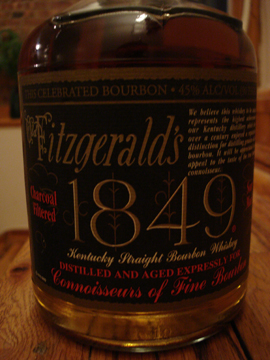
During my research I was particularly trying to find out where the 1849 date originated.  It turns out that it’s from the founding date of W.L. Weller & Sons, the previous owner of the brand.  Originally it may have been called Weller 1849, but subsequently changed by Heaven Hill.

The labeling is nothin if not complex.  It follows a black/gold/red color scheme and aligns its text to a number of different verticals.  The sadly obligatory block-o’-text sits on the top right corner of the front label (usually this is found on the back) and the date is adorned with odd agrarian flourishes.  Despite, or almost because of this the over all effect is not that OF1849 is trying too hard to be old-timey, but that they merely stopped trying to affect any specific presence a number of decades ago.  It’s not trying too hard, it just stopped trying – and I like this. [Update: same bottle as W.L. Weller Antique…]

Sure, it’s not something that jumps out at you from the shelf, but its uncool aesthetic makes it come closer to that ever-desirable “authenticity”.  If you needed any further proof of the uncynical design choices, look at the bottom of the label where it declares in the most unironic of phrases: “Distilled and aged expressly for [line break] Connoisseurs of Fine Bourbon.”  Excellent.

Tasting:

Old Fitzgerald 1849 has one of the strongest open-bottle-whiffs of anything I’ve tasted so far.  As soon as you crack that plastic cap, you receive a distinct scent of freshly-picked apples.  After pouring it, the apples continue, but are accompanied by mowed-grass, corn, and a distant mint – simple but pleasant.

On tasting OF1849 was not as smooth as I’d expexted, exploding onto the tongue.  This develops, however into caramel apples, some oak, popcorn, and tres leches cake.  In other words, this is certainly sweet.  The popcorn which develops in the middle adds an interesting contrast to the rest of the swirl.  There’s also quite a nice mouth-feel to it and a spicy-to-clean finish.

Over all:

I have to admit, what they say about Old Fitzgerald 1849 is right.  This is a damn good bourbon for less than $20.  While not as prototypical as Old Grand-Dad, there’s plenty to it to keep you interested that more expensive choices lack.  Well done.