Tag Archives: Bourbon

Cabin Still

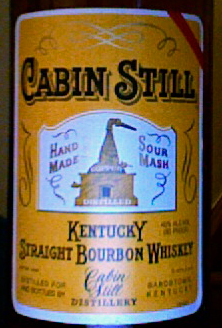
cabinstillApologies for the poor picture-quality, I still can’t find the charger for my camera battery.

I made a trip to Astor Place this weekend to pick up my next few bottles.  Catching my eye down there at the bottom shelf was Cabin Still with its bright yellow label and trying-too-hard name, so I put it in the basket along with my other selections and hoped for the best.  At $10.99, that’s not hard to do.

Further investigation revealed that Cabin Still is a Heaven Hill product, which bodes well.  Let’s see how this goes.

Stats:

– $10-12

– Made by Heaven Hill

– 80 proof

Presentation:

That yellow label is the most distinctive element of the Cabin Still bottle.  The centerpiece is a print of a copper pot still framed by the phrases “Hand Made” and “Sour Mash”.  The main text of “Cabin Still” is in a font that I don’t think I’ve ever seen before, but it – along with the decorative swirls around the edges – highlights the almost goofy character of the design.  It has taken the idea of the bourbon bottle and taken it to cartoonish lengths.

As much as I get fed up with the over-reliance on nostalgia in American whiskey packaging, I find myself more amused than frustrated.  I especially like after thought of a red stripe in the top red corner.

Tasting:

To the nose Cabin Still is sweet, medicinal, and a bit of new car smell.  On the palate, CS is barely there.  It starts off with a watery grain and under-aged sort of profile then drops into a faint char and a slight pepper on the finish.

Over all:

Cabin Still is nothing to write home about.  I’ve had worse as parts of bourbon & cokes before, but I don’t think I’ll be sipping this on its own any time soon.

Wasmund’s Single Malt Whisky

wasmundsI picked up Wasmund’s at Astor Place last week because it is a non-bourbon American whiskey that I’ve never heard of before.  That intrigues me.  I’m always looking for people who are innovating and trying new things in the spirits industry here in the US, even if that means attempting to recreate another nation’s approach, as the “single malt” moniker implies.

Another intriguing element of Wasmund’s is its age of…wait for it…four months.  Four months!  There I was, looking at a bottle filled with brown whiskey that’s four months old?  At the very least, this would be an experience similar to Georgia Moon or perhaps last week’s brandy, both young spirits.  At best, the creator had worked some distillation magic and produced a fine, but extremely young drink.  Either way, it would be interesting.

Stats:

$30-40

– Made by Copper Fox Distillery

– 96 proof

Presentation:

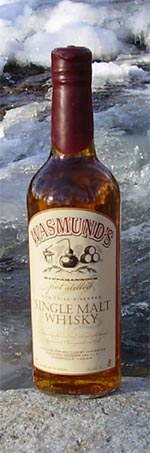
Wasmund’s label is nothing special.  It displays its name in bold red letters at its curved top, below which are depicted an axe & chopping block (having recently chopped some wood chips), a copper pot still, and a trio of casks.  In no fewer than four more fonts, the label describes where it’s from, that it’s non chill-filtered, that it’s a single malt whisky (no ‘e’), and that it’s falvored and colored with applewood, cherrywood, and oak.  In the background there’s a stylized fox.

There are too many fonts to allow me to enjoy this label.  The color scheme (red, black, tan) is attractive enough, and – individually – the graphic elements are passable, but over all it comes across as cluttered and unfocused.  They would be better off focusing on the fox logo as a central element and cutting down the font-madness.

I have seen worse, however.

On the back label, creator Rick Wasmund makes the case for his whisky.  He describes following a traditional Scottish method, except replacing peat with fruit woods: interesting.  He also says that the spirit is aged in casks along with wood chips: that explains the mere four months of aging!

Aging with wood chips is a common practice amon home-distillers who lack access to proper casks to mature their product, but I can’t recall any other commercial brand that uses this practice.  In theory it makes a lot of sense: whiskeys reach maturity as a result of its contact with the wood, therefore if you increase the exposed surface area of wood, you wll reach maturity faster.  Having been founded only in 2000, Copper Fox is a young operation, and most likely saw this method as a way to bring the product to the market in a shorter time frame – namely, four months.

Clever.  Whether or not this turns out well, I applaud Mr. Wasmund for his willingness to experiment and question orthodoxies in the American whiskey industry.  We need more people trying more methods in order to stay relevant and to push our industry further.

Tasting:

To the nose, Wasmund’s is largely made up of smoke, rubber, wood, and alcohol.  The wood scent is not the familiar oak; this must be the apple and cherry woods described.  Yet, the youth of this whiskey comes through in the harsh alcohol scent that accompanies it.

On tasting, the prominent sensation is something like salt cod, beyond which lies that non-oak wood, a bit of smoke, and a general impression of the ocean.  The finish is long, hot, and peppery.

This is surpisingly mature for a four (!) month old whiskey, but still clearly young.  The flavors come and go with a speed and clarity that belies their variety and its heat, if nothing else, betrays its youth.

It is also definitely in the Scotch style.  That oceanic sensation is a reflection of this, perhaps owing to the smoking of the barley before fermentation.

Over all:

This is not my favorite whiskey.  It is, however, a good effort at breaking the accepted practices of whiskey making in America.  We should judge practices like aging with wood chips by the spirits they produce, rather than by the processes we are familiar with. In that light, though they are far from where they could be, I encourage Mr. Wasmun in his efforts, and hope to see other varieties from Copper Fox soon.
Baker’s (mini-bottle)

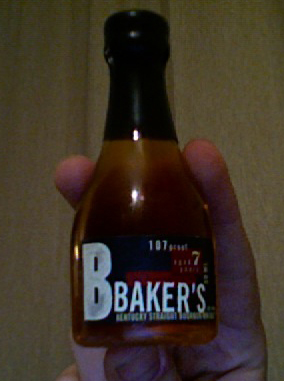
bakersMy little brother was thoughtful enough to give me a sampler for Jim Beam’s Small Batch Bourbon Collection over the holidays, so I saw this as a perfect time to complete my reviews of this line by tasting Baker’s.  (You can find the other’s here: Knob Creek, Basil Hayden, Booker’s)
What does it mean that I’m reviewing something in its mini-bottle form?  Honestly, I’m not too certain either.  Sure, this didn’t make it into the full-bottle batch and this can’t be experienced in the same way that the full bottle could; on the other hand, its the same stuff inside and it seems that Beam has taken great care with the miniature versions of their Small Batch Collection.

Stats:

– Probably a few dollars by itself

– Made by the folks a Jim Beam

– 107 proof

Presentation:

While it’s difficult to judge a bourbon’s bottling when in mini-bottle form, the small batch collection minis do seem to hold largely true to their bigger-bottle form.  Knob Creek mini has its distinctive angular form and Basil Hayden mini has its tall, distinguished proportions.  Baker’s and Booker’s bottles are given a tear-drop form that is only mildly reminiscent of their actual shape, but represent a valiant effort in miniaturization, regardless.

I do remember liking the Baker’s distinctive capital B and use of type during visits to the bar and the mini-bottle uses this same motif to only slightly more confusing effect (the capital ‘B’ is right next to the ‘B’ in “Baker’s” making it look like “BBaker’s”.)

Lines and fills are ever so slightly rough and overly bold in order to mimic an old letter press and come in varying typefaces.  One edge of the label is serrated while the others are smooth.  All in all, this comes across as the older brother of Knob Creek.  Not afraid to stray from the yarns of long-dead grandfathers that adorn other bourbons, but not dispatching with a sense of history over all.

Tasting:

Very upfront nose.  Citrus, grass, roasted almond, fresh cherry.  There is very little subtlety about this aroma, but it is pleasant and un-astringent for a 100+ proofer.

On tasting it’s sweet, with some notes of oats and citrus, finishing with a nice lingering warmth and some tanginess, this settles into a vanilla-and-smoke after a while.

Over all:

Baker’s is not shy.  It is bright for the most part and settles into something a little more subdued over time.  I actually like this one quite a bit – and it may even be my favorite of the small batch collection from Beam.  That said, it also is the one that reminds me the most of Jim Beam black – and that’s not a bad thing in my book.

I’ll have to pick up a full-sized edition when I get a chance.

Jefferson’s Reserve

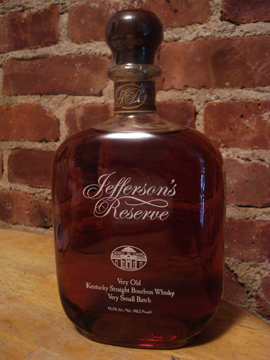
jeffersonsreserveJefferson’s Reserve is one of the three “Very Small Batch” offerings from McLain & Kyne (of Castle Brands).  It seems that by “Very Small Batch” they mean it’s the product of only eight to twelve barrels, but this is the only time I’ve seen the term used with the “very” modifier.
From what I’ve been able to glean from a few minuted of research, JR is (or was originally) produced at the same place as Willett’s, nearby Heaven Hill.  The pricing and name-checking of a particularly gentlemanly President demonstrate the producers’ intentions of placing this bourbon firmly in the super-premium category.

Stats:

– $45-55

– Made by McLain & Kyne

– 90.2 proof

Presentation:

Jefferson’s Reserve comes in a very simple, refined bottle, marked by its lack of a front or back paper label.  The front sports the brand name in a flowing script intended to mark the distinguished nature of the bourbon within and perhaps to conjure the former President’s spirit.  Below this is a small image of Monticello, again recalling Jefferson’s grand style of living to which we might aspire.  The only other text on the bottle is “Very Old / Kentucky Straight Bourbon Whisky / Very Small Batch.”

First of all note the use of “Very” to modify both “Old” and “Small” – as I mentioned earlier, “Very Small Batch” might be a brand-associative term for McLain & Kyne, but also applying it to “Old” just seem gauche in a way which Jefferson himself would never approve.  It also seems that Jefferson’s Reserve once did have a distinct age statement (15 years), but they’ve ditched that in recent years.  Likely they’re using barrels from a number of different year now to meet the flavor profile, but the average age is likely not far from 15 I would guess.

Secondly, note that they use “Whisky” instead of the more common spelling (for bourbon) “Whiskey”.  This seems to be another distinguishing mark meant to connect the bourbon to an older tradition than its competitors.  A subtle move; or as McL. & K. might put it, Very Subtle.

Tasting:

Jefferson’s Reserve has a quiet, but pleasant aroma to it.  I was able to pick out strains of raisins and dried summer grass.  This is not something that will jump out at you as soon as you open the bottle, but it comes in time.

On the palate, JR is equally quiet.  Starting with unsweet sensations of vanilla and grass, these quickly dissipate into a very clean finish, but not before a quick, sharp spark of tobacco comes and goes.

I’m surprised not to be tasting more wood, considering how old this is supposed to be.  That’s a commendable trait – often it seems that in a rush to compete with scotch, bourbons are over-aged and become too woody.

Over all:

If you’re looking for depth of flavor and complexity, Jefferson’s reserve is not for you.  If you’re looking for subtle flavors and the air of something Very Refined, have a go at it.  For this price point, make sure you’ve had a number of other bourbons first, however.  I think there are a few other options lower on the price scale that would fit into a similar tasting category.

The American Hooch 2008 Gift Guide

I’ve gotten questions from many friends and co-workers about what bourbon they should buy for their friend/boyfriend/roommate for the holiday season.  This is always a difficult thing to judge since some of the best wiskies don’t always make for the classiest gift, but on the other hand many of the gift-like bottles aren’t the most original or demonstrative of taste.

With that in mind, here’s my American Hooch 2008 Gift Guide to help you navigate your social relationships with a properly chosen bottle of alcohol.

The Mantle Piece Bourbon

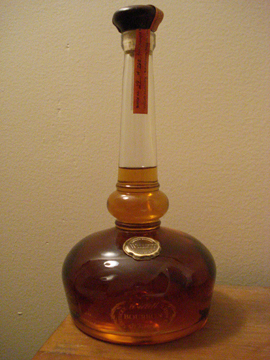
willettThis one is for that someone on your list who wants something to show off to folks stopping by over the holidays.  Willett Family Pot Still Reserve is certainly a fine tasting bourbon, with notes of butterscotch, cherry-sweetness, and honey, but it is most impressive in its profile.  Your receipient will not only be impressed with the pot still shaped bottle, but also the wonderfully gurgly noise it makes when you pour.  I wrote about it here.
This one might be a little tougher to find, but it will make an immediate visual impression.  It will also run you around $40.

Continue reading The American Hooch 2008 Gift Guide

Corner Creek Reserve Bourbon Whiskey

cornercreekThe other night I was on my way to my girlfriend’s apartment after work and decided to pick up a bottle of wine for dinner.  I stopped into fairly large (for Brooklyn) liquor store in her neighborhood and, of course, had to spend a bit of time in the bourbon/American whiskey section.
I didn’t intend to get any whiskies, but I picked up Corner Creek Reserve without much forethought.  It was in a reasonable price range and is not something that you see every day, so I figured I’d give it a try.  I left with it and an inexpensive bottle of wine.  You can see where my alcoholic priorities lie.

Stats:

$20-25

Made by Corner Creek

88 proof

Presentation:

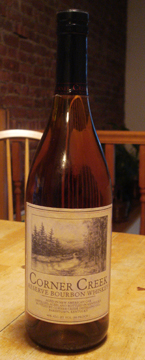
The thing that most people will notice about Corner Creek Reserve is that it comes in a green-tinted wine bottle.  That alone will make it stand out on most everyday liquor store bourbon shelves, but it also seems to be a part of a larger positioning play by the company, which I’ll get to in a moment.

The front label is dark blue ink on unbleached paper with a fine, red border line.  It is dominated by a print of what we must assume is the eponymous creek, below which is the name and basic aging and production information.  The font is a rustic serif set in a very matter-of-fact style, giving a sense of openness to the packaging that contrasts the cluttered nostalgia of many bourbon bottles.

The copy on the back tries to tie what Corner Creek is doing to the selection of fine wines: “In the tradition of the great wine importers, we … search for the the elusive few great barrels of prime aged American whiskey, and offer it to you in this limited bottling.”  This is a clever tactic, likely meant to draw in curious (and apparently snooty) oenophiles who might be put off by the usual peculiarities of bourbon packaging.

This is where CC’s product positioning becomes clear, they have created a bottle that looks and appeals to wine drinkers and noticably eschews the common bourbon tropes in favor of common wine tropes.  They’ve gone for classy rustic instead of the bourbon favorite trio of old men, old recipes, and old times.

Tasting:

Corner Creek Reserve does not have much of a nose to it.  It feels tight and pretty locked-up in comparison with its usually more bombastic bretheren.  You can search, but really all you’ll find is a bland sweetness with maybe a hint of ash.

Things open up a bit more on the palate.  I got pine, some distant smoke, along with the usual corn/caramel.  The finish is largely smooth but lingers a bit with a smooth creaminess.

One thing I can say about this over all is that it is very smooth.  It is more like Basil Hayden’s in this way, but without as much complexity.  Goes down easy despite the 88 proof.

Over all:

I have to hand it to Corner Creek, they’ve created the perfect bourbon to capture wine drinkers.  Everything from the presentation to the liquor itself seem tailor made to draw someone away from their cabernets and merlots.

It’s a good, smooth bourbon that won’t get you too excited, but which I’ll probably bring out for folks who like a milder drink or are nervous about leaving their oenophile ways.

American Honey

american_honeyI didn’t choose this week’s tasting for its nominal similarities to the blog, but I’d be lying if I said it was completely unrelated.  I first read about American Honey in Malt Advocate (I think?), but finally saw it in the corner liquor store a few days ago and decided to give it a try.

Last winter I started mixing honey with bourbon every now and then to great effect as a simple, enjoyable winter drink.  I’d imagine AH does a fine job coming from such inspiration, but I’m worried that it will stray too far from the simple mixture of its roots.

Stats:

– $20-25
– Made by Wild Turkey / Austin, Nichols
– 71 proof

Presentation:

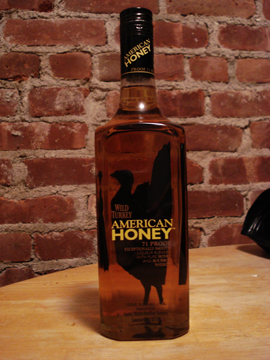
The bottle is quite attractive: sleek, simple, and unadorned – yet it begins to approach the dangerous territory of chic vodkas.  The major visual element is a silhouetted turkey on the rear of the bottle.  Otherwise the design consisted of a clearly printed “American Honey” on the front along with a brief description.

Perhaps thankfully, a long-winded, tall-tale origin narrative isn’t expected of this product.

Tasting:

A careful whiff demonstrates that this is indeed bourbon – you can definitely smell the char and wet grass elements.  It is definitely much softer and and lighter as one would expect.

On tasting, it opens strongly with honey then moves more into its bourbon elements of oak and hay.  What takes me most off guard is the almost floral finish to it, odd.  This is most certainly different from the mixtures I’ve whipped up at home.

Over all:

I like this, but I’m not sure I’d buy it on a regular basis.  It doesn’t offer much beyond what you might get by adding a bit of simple syrup to your bourbon.  That said, there are some interesting qualities to it that go beyond a simple honey/bourbon concoction that might merit further exploration in the realm of cocktails.

Basil Hayden’s

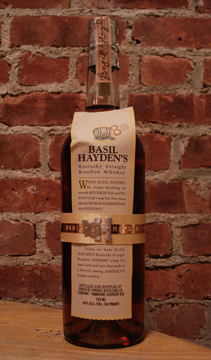
basilhaydenBasil Hayden’s is the other of Jim Beam’s top-shelf selection, along with Booker’s and Knob Creek which I’ve written about before.  I’ve heard that BH is a lot smoother and gentler than those other two.  That could be a good or a bad things depending on who’s saying it and what the occasion is, though I have to admit I prefer a bolder drink so I’m a little wary.  On to the stats!

Stats:

  • $30-$40
  • 80 proof
  • Made by the Jim Beam folks

Presentation:

Certainly the bottle reflects Basil Hayden’s relative lighness to an extent.  Soft tones and carefully constructed curves contrast with Booker’s homemade feel and Knob’s bursting angularity.  The labeling is actually pretty interesting.  It consists of a smooth, brown paper tunic over the neck of the bottle and extending down the sides and belted by a band of wood and copper.

I like the consistent soft coloring and relatively minimal look, but the story about George Washington and the four-year-old state of Kentucky is a little schlocky.  I suppose anyone who’s read this blog before could have seen that coming.

Tasting:

Basil Hayden’s immediately lets off a sweet aroma once it is poured.  While strong, further inspection opens up tree bark and dry wheat, but remains powerfully candied all along.  Candied wheat?  Is that a thing?

On tasting, there is a quick hint of the explosiveness of Knob Creek, but it quickly fades into a strawberry mingled with a bit of spice.  Toward the end there’s a slow burn of something like dry corn followed by a very clean and easy finish.

One thing that did surprise me here was the mouth feel – it was much bigger than I’d expect from the lighter end of the Beam small-batchers.

Over all:

Basil Hayden’s was very pleasant.  Just now I’ve poured myself another tasting, in fact.  But ultimately it’s nothing to get excited about.

It would make an excellent introductory bourbon for the uninitiated or those used to lighter fare, but only if it weren’t so pricey.  This will be nice to have around and contrast with some of the rest of my collection, but isn’t my favorite of its immediate family.

Old Fitzgerald 1849

My apologies.  It’s been a few weeks since I’ve been able to get around to blogging here.  The first delay was on account of going to a Bulleit tasting at the Brandy Library (it got a little rowdy for the BL) and the second delay was from me being off in Germany last week where bourbon is not a priority for the locals.

Now that I’m back, I’ll try instituting a new section to the regular posts, a “Stats” section which will list price range, proof, and maker – thanks for the idea, Dave!

First up on my return: Old Fitzgerald 1849.  On my last trip to Lenell’s, I specifically asked for something from the lower end of the price-scale.  Both my wallet and my instincts were telling me that I’d been focusing a bit too heavily on $30+ bottles and it was time to look a little lower.  I’d had good experience with the Old Grand-Dad Bonded, so surely there were other gems among this, the everyman’s liquor.  I think it was Ingrid there who recommended OF1849.

Before tasting, I did some quick internet-research and found that you can’t go very far without coming across accolades for OF1849 as a bourbon with a high quality-to-price ratio.  These are high stakes that were set up for the product.  I hoped it would stand up to them.

Stats:

  • Under $20
  • 90 Proof
  • Made by Heaven Hill

Presentation:

During my research I was particularly trying to find out where the 1849 date originated.  It turns out that it’s from the founding date of W.L. Weller & Sons, the previous owner of the brand.  Originally it may have been called Weller 1849, but subsequently changed by Heaven Hill.

The labeling is nothin if not complex.  It follows a black/gold/red color scheme and aligns its text to a number of different verticals.  The sadly obligatory block-o’-text sits on the top right corner of the front label (usually this is found on the back) and the date is adorned with odd agrarian flourishes.  Despite, or almost because of this the over all effect is not that OF1849 is trying too hard to be old-timey, but that they merely stopped trying to affect any specific presence a number of decades ago.  It’s not trying too hard, it just stopped trying – and I like this. [Update: same bottle as W.L. Weller Antique…]

Sure, it’s not something that jumps out at you from the shelf, but its uncool aesthetic makes it come closer to that ever-desirable “authenticity”.  If you needed any further proof of the uncynical design choices, look at the bottom of the label where it declares in the most unironic of phrases: “Distilled and aged expressly for [line break] Connoisseurs of Fine Bourbon.”  Excellent.

Tasting:

Old Fitzgerald 1849 has one of the strongest open-bottle-whiffs of anything I’ve tasted so far.  As soon as you crack that plastic cap, you receive a distinct scent of freshly-picked apples.  After pouring it, the apples continue, but are accompanied by mowed-grass, corn, and a distant mint – simple but pleasant.

On tasting OF1849 was not as smooth as I’d expexted, exploding onto the tongue.  This develops, however into caramel apples, some oak, popcorn, and tres leches cake.  In other words, this is certainly sweet.  The popcorn which develops in the middle adds an interesting contrast to the rest of the swirl.  There’s also quite a nice mouth-feel to it and a spicy-to-clean finish.

Over all:

I have to admit, what they say about Old Fitzgerald 1849 is right.  This is a damn good bourbon for less than $20.  While not as prototypical as Old Grand-Dad, there’s plenty to it to keep you interested that more expensive choices lack.  Well done.

Kentucky Vintage

The selection of Kentucky Vintage was not the result of the most pointed recommendation process.  I had never read or heard anything about it and it was recommended to me at LeNell’s only after it became clear that I had already exhausted the my guide’s first few rounds of suggestions.  That’s what this blog is all about though, right?

Kentucky Vintage comes to us from the folks who make Johnny Drum, Rowan’s Creek, and a few other familiars on liquor store shelves.  Judging by their website, Kentucky Bourbon Distillers has a broad and slightly disorganized product range in a variety directions – all the more for us to taste, I suppose.

Presentation:

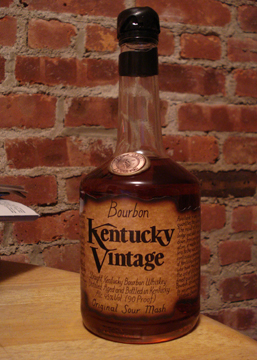
The labeling on Kentucky Vintage seems to be a distillation of everything I complain about in bourbon labels: faux-aged, faux-burnt edges, Comic Sans-esque lettering, and (three!) long winded descriptions.  To top it off, they’ve dipped the plastic screw-top in wax.  Yet, to their credit, it seems their hand-numbering is legit, as is their medallion pressed into wax on the front.

The bourbon is small batch, 90 proof, and of an age only described as “long beyond that of any other bourbon,” hmmm.  This doesn’t mean anything other than it’s older than four years, legally, but it would be nice to imply a range from which they’ve selected.

Tasting:

To the nose Kentucky Vintage is pleasant, if subdued.  Dominated largely by char and a saltiness, there are also notes of sweet pears and oak.  It is neither rough nor complex, but hits a middle ground that just misses the “boring” range and lands in “pleasant”.

On tasting KV’s dominant sensation is saltiness start to finish.  Further inspection reveals that there isn’t too much more than that except corn and a hint of char in the middle.  This really tastes much greener than something aged “long beyond that of any other bourbon” should taste.  In a blind tasting, I’d be surprised if this were even four years.

Over all:

I was hoping that the clumsy presentation of Kentucky Vintage reflected an honest concentration on the bourbon itself – as it should be – but I was ultimately disappointed.  Judging by the range of bourbon sold by Kentucky Bourbon Distillers, they would do well to take a hard look at some of their expressions.