All posts by Nathan

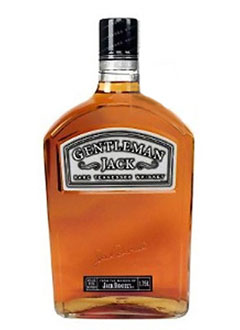
Gentleman Jack

gentlemanjackI feel a little like I’m going about this wrong – writing about Gentleman Jack before the standard Jack Daniels.  Gentleman Jack is the middle offering in the Jack Daniel’s, Gentleman Jack, and Jack Daniels Single Barrel, so it would seem natural to start with the first rung of the ladder.  Unfortunately, college provided me with too many tasting experiences of the standard Jack Daniel’s to be as unbiased as I’d like.  The Gentlemanly variety, then, provides something of a fresh start for this popular brand.

The difference between GJ and JD seems to be only that the whiskey is charcoal filtered twice instead of once.  Presumably this will make it a little smoother.  There’s also no age statement, providing them with some flexibility with this line.

Stats:

– $30 – 40

– 80 proof

– Made by Jack Daniel’s

Presentation:

Gentleman Jack’s bottle has a wide-set shoulder, with a slight slope on the way down to the base.  The front sports a silver label emblazoned with its name and the descriptor “Rare Tennessee Whiskey”.  Beneath this, embossed on the glass is Jack’s signature.  Otherwise, the bottle is pretty clean and simple, showing off the stuff inside.

Tasting:

Gentleman Jack is very sweet to the nose – corn, fresh grass, and reasonably strong oak.  It is indeed very smooth, clean start to clean finish.  In the middle, though, there’s a bit of a crunchy, grainy aspect that fodes quickly to a warm char on the roof of the mouth.

Over all:

Gentleman Jack is – as advertised – quite smooth.  Unfortunately, there’s not too much else going on in there.  I’ll give this a try with some cocktails and see how it holds up.  In the end, however, this probably won’t be making too many appearances for me.

Michter’s US-1 Unblended American Whiskey

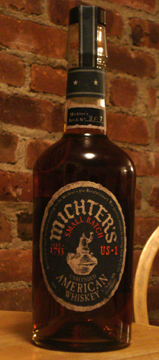
michtersawMichter’s has been one of those whiskeys that I think about buying every time I’m stocking up, but never do.  It is in most liquor stores in the city that have anything approaching a decent whiskey selection so it’s easy to turn up the opportunity to buy it with the ‘there’s always next time’ rationale.  Well, this past Sunday was the ‘next time’ I suppose, because I finally picked up a bottle of Michter’s American Whiskey.

What makes it American whiskey as opposed to bourbon?  It seems that the difference lies in their use of “bourbon soaked” oak barrels (i.e. previously used barrels) and the use of their unelaborated “signature filtration” process.  This should be an interesting counterpart to some of the other selections from Kentucky on this blog.

Stats:

– $30-35

– 83.4 proof

– Bottled by Michter’s American Whiskey Company

Presentation:

Michter’s American comes in a bottle with a reasonable diameter and tall-ish neck – largely a design which doesn’t stand out and is only a step different than the standard well bottles.  The front label is a blue, rough-edged oval edged by a mottled grey border.  In the middle is an image of a pot still surrounded by text in ever-larger rings.  The outermost of these text rings brags that MAW is distilled according to “pre-Revolutionary War” quality standards – which I have to say it not much comfort considering the fresh-off-the-still stuff they probably drank back then.

I do like the double-banded binding on the neck and cork.  Adorned sparsel with stars against a dark blue, this feature exudes a restrained but nonetheless present patriotism.

Tasting:

The nose on this one has a bit of depth to it, fresh cream, malted barley (?), raspberries.  A little confused about the malted barley here, but it could just be whatever rye elements are in the mash mixing with the other scents.

Taste: Very smooth.  Initally there’s that rye undertone that’s overtaken by lemon candy, fresh corn, and then moving to a syrupy-sweet taste.  It ends with a rye-like bitterness and a warm finish of moderate length.

Over all:

This is not my favorite.  I tend to be drawn to whiskeys that have a bit more depth to them and some sharper edges, and this isn’t exactly what I’ve got here.  Perhaps contradictorily, however, I can definitely see myself drinking this regularly.  It’s a fine whiskey that’s easy to get into and doesn’t provoke much thought.  The lack of depth here works in its favor as an every-day sort of drink since what it does display is actually pretty good.

On Wine vs. Whiskey & Russell’s Reserve Rye

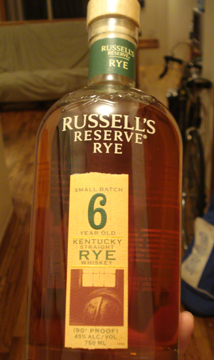
russellsreserveryeIf you missed me last week, that’s because I was traveling about France, doing very little in the way of tasting American liquors – bourbon especially.  In fact, I managed only one type of liquor over there: a single Calvados whose name I don’t even recall.  Instead, I did what I could to get a taste of the wine world, and in particular, I delved into the world of Burgundies.  Thanks, in large part to David and Lynne.

Naturally, there is quite a bit different between the philosophies of distillers and vintners, but at times I was surprised at the gap between the two.  For instance, the concept of a “single barrel” wine is simply not in the picture for vintners – and this really points to the larger issue at hand: everything that occurs after the harvest of the grapes is important to do correctly, but largely inconsequential to the end product.  With whiskeys on the other hand, where and how the grain is grown bears little importance in the final product and the artistry lies in the post-harvest crafting.  Very interesting to think about, and one would imagine the two worlds might have a bit to learn from each other.

Now that I’m back in my dear States United, however, I’m good and ready to dive back into the good stuff – built from grain, aged in oak.

And what better welcome back into the country than a bit of Russell’s Reserve Rye?  I met Jimmy Russell himself at a tasting at the Brandy Library a few months ago, where he poured me a few of the “Russell” branded Wild Turkey offerings including this very one – though the drink’s subtleties were probably lost in Jimmy’s charming conversation.

So with that, I’m going to give this one a proper American Hooch eye and see what it has to offer.

Stats:

– $30-35

– 90 proof

– Mady by Austin, Nichols (Wild Turkey)

Presentation:

Russell’s Reserve Rye comes in what can only be described as a straight-forward bottle.  Everywhere you look it has clean edges, straight lines, and bold lettering.  The label is an aporximately one-inch thick, four-inch high, vertical strip at the bottom of the bottle declaring the basic information that what you have before you is “Small Batch 6 Year Old Kentuck Straight Rye Whiskey,” with a small monochrome photo of a barrel beneath a window.  Above that, printed on the bottle is the product name and a raised glass signature, and the bottle is topped off with a pale wooden cap that is adorned only in its modest height and simplicity.

The text on the back does bring a bit of out-of-place adornment, praising Jimmy and his son Eddie as “America’s premier whiskey makers” and awarding their own product as “the perfect 6 year old rye.”  There’s nothing wrong with pride in many circumstances, but here it belies the classy no-nonsense approach to the design of the rest of the bottle.

Tasting:

RRR has a very attractive and surprisingly deep scent to it.  It starts with fresh-baked bread and moves into a fruit-sweet, fresh-cut grass tainted by charcoal note.  This very much reminds me of warmer weather and Sunday afternoons.

It is not nearly as smooth on the tongue however, with all the elements of rye (and its high proof) bursting through right away.  Along with the initial brightness though, there’s a creamy, almond flavor to it.  As this fades into the fairly sweet finish, the almond aspect develop into a dominant note with touches of the rye-driven bitterness creeping in on the sides.

There’s a lot going on here.

Over all:

This is a very well crafted whiskey.  It hits all the points that I usually enjoy, especially the sweet/bitter contrast that plays so nicely.  I could also see this making an excellent Old Fashioned – as long as you kept the recipe as simple as possible so as to take advantage of the bright almond notes in Russell’s Reserve Rye.

Very well done.

Clear Creek’s Eau de Vie de Pomme

eaudeviedepommeI’m off to France for the next week, so that means two things for this blog: first, it means there won’t be an entry next week – unless I’m able to find a worthy American liquor over there and get into the blogging spirit, I suppose; and second, it means that in my anticipatory mood I’ve picked up a bottle of Clear Creek’s Calvados-inspired apple brandy to write about.

I first found out about Clear Creek’s apple brandy in the (perhaps not defunct?) New York Times blog Proof, where CC’s Steve McCarthy contributed a few pieces.  I was never able to really get into that blog, which seemed to at once celebrate, nostalgize, and demonize alcohol – a confused premise at best.  However, Steve’s pieces gave me a glimpse into the motivations and processes behind a respected American distiller, especially his emphasis on leveraging a region’s local produce in production.

Now let’s get down to some tasting.

Stats:

– $30-40

– Made by Clear Creek

– 80 proof

Presentation:

Clear Creek’s Eau de Vie de Pomme makes no apologies for its Francophilia.  Everything from the shape of the bottle, to the label coloring, to the script imitates the Calvados style.  With that in mind, I enjoy the crisp lines and simple alignment of the text and border on the label, allowing the flowing script of the French title to stand out without cluttering.

There is not too much information on the bottle itself except the age statement (8 years) and that it has been aged in French oak.

Tasting:

EdVdP is light brown in color – a testament to its eight year aging – but is not as dark as what you might expect from some brandies (though certainly darker than the last apple brandy I wrote about here).  The scent is strongly of cider and quite sweet.  There might be a touch of the wood to the nose as well, but it was hard to pick out from the cidery notes.

On tasting, EdVdP is bright and apply and lingers on the tongue with a tingling citrus and a bit of that French oak.  Despite the apple and citrus, this was not as sweet as the scent would have you believe.

Over all:

Perhaps I’m not as adept at navigating the complexities of brandies just yet, or perhaps I simply shouldn’t expect as much from them in that manner as I should from bourbon.  Either way, while Clear Creek’s Eau de Vie de Pomme is thoroughly enjoyable and I will visit the bottle again, I wasn’t able to draw as much character out of it as I would normally look for.

What I can say, however, is that through the lens of my admittedly limited experience with brandy and Calvados in particular, Clear Creek seems to have done a good job in imitating the qualities of the French liquor.  In the end, it could cetainly stand on its own legs without the comparison.

Cabin Still

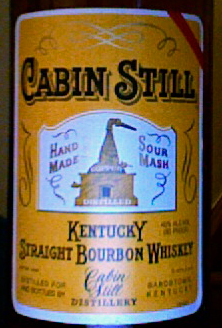
cabinstillApologies for the poor picture-quality, I still can’t find the charger for my camera battery.

I made a trip to Astor Place this weekend to pick up my next few bottles.  Catching my eye down there at the bottom shelf was Cabin Still with its bright yellow label and trying-too-hard name, so I put it in the basket along with my other selections and hoped for the best.  At $10.99, that’s not hard to do.

Further investigation revealed that Cabin Still is a Heaven Hill product, which bodes well.  Let’s see how this goes.

Stats:

– $10-12

– Made by Heaven Hill

– 80 proof

Presentation:

That yellow label is the most distinctive element of the Cabin Still bottle.  The centerpiece is a print of a copper pot still framed by the phrases “Hand Made” and “Sour Mash”.  The main text of “Cabin Still” is in a font that I don’t think I’ve ever seen before, but it – along with the decorative swirls around the edges – highlights the almost goofy character of the design.  It has taken the idea of the bourbon bottle and taken it to cartoonish lengths.

As much as I get fed up with the over-reliance on nostalgia in American whiskey packaging, I find myself more amused than frustrated.  I especially like after thought of a red stripe in the top red corner.

Tasting:

To the nose Cabin Still is sweet, medicinal, and a bit of new car smell.  On the palate, CS is barely there.  It starts off with a watery grain and under-aged sort of profile then drops into a faint char and a slight pepper on the finish.

Over all:

Cabin Still is nothing to write home about.  I’ve had worse as parts of bourbon & cokes before, but I don’t think I’ll be sipping this on its own any time soon.

Stranahan’s Colorado Whiskey

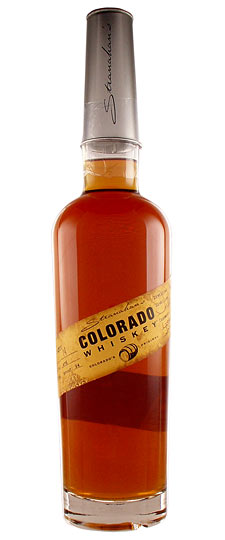
stranasI apologize to my readers for the recent lull in my posting schedule.  I spent ten days down in Austin then another ten recovering – in not much of a mood for liquor.  The blog may have also experienced some down-time lately, hopefully that should be fixed now.  This week, however, I have something a little different: a “Colorado whiskey” – namely Stranahan’s.

Anyone who has read this blog before might have noticed that I like to cheer on whiskies that originate from outside the Kentucky/Tenessee region.  I like to imagine that the further one gets from the heart of bourbon production, the more willing one is to experiment with production.  While this is blatantly not true – with the wonderful experimentation going on in Kentucky and some traditional products coming from elsewhere – it’s at least an interesting draw into new ground for me.

Stranahan’s is made like a bourbon, except with an all-barley mash instead of a corn-centric one, and aged a “minimum” of two years.  Let’s see how it pans out.

Stats:

$50-60

– 94 proof

– Made by Stranahan’s Colorado Whiskey

Presentation:

The large metallic silver top defines this bottle’s appearance.  It may look like a shot glass and/or serving suggestion, but at this price point, I hope that’s not the case.  Otherwise the steeply angled labeling is simple, with an emphasis on hand-marking.  The background is faux aged and the descriptive paragraph very short.  One appealing aspect is the “Comments” section of the label where “listening to the Pogues” is written in, a charming addition if it’s genuine. These guys might just be small enough for that to be real.

Tasting:

To the nose Stranahan’s comes across with hot asphalt, watermelon, honey, and salty ocean wind.  The latter two Scotch-like notes are probably a result of their common use of barley.  The scent is smooth and without any significant alchohol character to it.

Tasting it again draws likeness to Scotch.  It opens with a big, bright lemony sensation that falls back into a dandelion bitterness that lingers for a bit before fading into a long, dry, warm finish that never really releases that first lemon aspect.

Over all:

I am impressed with Stranahan’s.  If you like your sweet bourbons you won’t be too pleased here since the barley doesn’t have that kind of sugary character, but it is different from any other American whiskey I’ve had lately – in a good way.

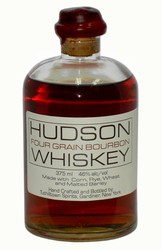
Hudson Four Grain Bourbon Whiskey

fgbI met Ralph Erenzo – co-founder of Tuthilltown Spirits – at a tasting at Fermented Grapes this weekend. I’ve tasted TS’s barley Single Malt before and I’ve been curious about their Four Grain Bourbon more or less since.  So, after tasting some of TS’s apple vodka and Baby Bourbon (as well as a pleasant conversation with Ralph) I took home a bottle.

Stats:

– $35-40
– 92 proof
– Made by Tuthilltown Spirits

Presentation:

As I’m sure I wrote before with the Single Malt, Tuthilltown Spirits squat little bottle with wax-dipped top is attractive for its lack of affect and medicine-bottle look, while avoiding the kitch and nostalgia of other American whiskies.  My only complaint is the wordiness of the paragraph on the back, which belies the rest of the packaging’s simplicity.

Tasting:
On the nose FGB is very muted.  There’s a bit of spicy, pepperiness from the rye as well as a sweet maple syrup scent.

The first sip enters smoothly and sweet, then develops a full-mouth grainy, grassy taste.  It’s here where it reveals some youth though (it’s aged less than a year in small barrels) and a little tartness, but it slowly moves into a medium-length peppery finish.

Over all:
Tuthilltown’s Four Grain Bourbon is pleasantly full.  If I didn’t know it had been aged less than a year (Mr. Erenzo let that out) I probably wouldn’t have been able to guess.  I’m looking forward to what they produce in the future.

Wasmund’s Single Malt Whisky

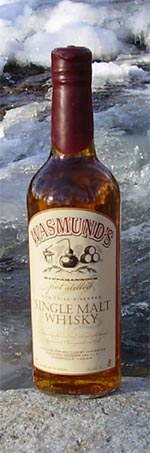
wasmundsI picked up Wasmund’s at Astor Place last week because it is a non-bourbon American whiskey that I’ve never heard of before.  That intrigues me.  I’m always looking for people who are innovating and trying new things in the spirits industry here in the US, even if that means attempting to recreate another nation’s approach, as the “single malt” moniker implies.

Another intriguing element of Wasmund’s is its age of…wait for it…four months.  Four months!  There I was, looking at a bottle filled with brown whiskey that’s four months old?  At the very least, this would be an experience similar to Georgia Moon or perhaps last week’s brandy, both young spirits.  At best, the creator had worked some distillation magic and produced a fine, but extremely young drink.  Either way, it would be interesting.

Stats:

$30-40

– Made by Copper Fox Distillery

– 96 proof

Presentation:

Wasmund’s label is nothing special.  It displays its name in bold red letters at its curved top, below which are depicted an axe & chopping block (having recently chopped some wood chips), a copper pot still, and a trio of casks.  In no fewer than four more fonts, the label describes where it’s from, that it’s non chill-filtered, that it’s a single malt whisky (no ‘e’), and that it’s falvored and colored with applewood, cherrywood, and oak.  In the background there’s a stylized fox.

There are too many fonts to allow me to enjoy this label.  The color scheme (red, black, tan) is attractive enough, and – individually – the graphic elements are passable, but over all it comes across as cluttered and unfocused.  They would be better off focusing on the fox logo as a central element and cutting down the font-madness.

I have seen worse, however.

On the back label, creator Rick Wasmund makes the case for his whisky.  He describes following a traditional Scottish method, except replacing peat with fruit woods: interesting.  He also says that the spirit is aged in casks along with wood chips: that explains the mere four months of aging!

Aging with wood chips is a common practice amon home-distillers who lack access to proper casks to mature their product, but I can’t recall any other commercial brand that uses this practice.  In theory it makes a lot of sense: whiskeys reach maturity as a result of its contact with the wood, therefore if you increase the exposed surface area of wood, you wll reach maturity faster.  Having been founded only in 2000, Copper Fox is a young operation, and most likely saw this method as a way to bring the product to the market in a shorter time frame – namely, four months.

Clever.  Whether or not this turns out well, I applaud Mr. Wasmund for his willingness to experiment and question orthodoxies in the American whiskey industry.  We need more people trying more methods in order to stay relevant and to push our industry further.

Tasting:

To the nose, Wasmund’s is largely made up of smoke, rubber, wood, and alcohol.  The wood scent is not the familiar oak; this must be the apple and cherry woods described.  Yet, the youth of this whiskey comes through in the harsh alcohol scent that accompanies it.

On tasting, the prominent sensation is something like salt cod, beyond which lies that non-oak wood, a bit of smoke, and a general impression of the ocean.  The finish is long, hot, and peppery.

This is surpisingly mature for a four (!) month old whiskey, but still clearly young.  The flavors come and go with a speed and clarity that belies their variety and its heat, if nothing else, betrays its youth.

It is also definitely in the Scotch style.  That oceanic sensation is a reflection of this, perhaps owing to the smoking of the barley before fermentation.

Over all:

This is not my favorite whiskey.  It is, however, a good effort at breaking the accepted practices of whiskey making in America.  We should judge practices like aging with wood chips by the spirits they produce, rather than by the processes we are familiar with. In that light, though they are far from where they could be, I encourage Mr. Wasmun in his efforts, and hope to see other varieties from Copper Fox soon.
American Fruits Apple Brandy

Just when you thought you were reading a blog devoted to whiskey, I pull out a brandy: an American spirit to no lesser degree however.  In fact, brandies – specifically apple brandies – have probably been in production in the US longer than grain whiskey of any type has.  Colonists in New England distilled hard cider into applejack using the freeze distillation method, resulting in a harsh beverage full of fusel alcohols.
Fortunately Warwick Valley Wine Company (NY) does not rely on freeze distillation to make their apple brandy.  Rather they use a copper pot still to refine their spirit, much to the drinkers’ advantage.  They also age it for one year in New York oak.  I’m a little doubtful that such a young bottling will be very interesting, but I am glad to see another product come out of the Northeast.

Stats:

– apx $25

– Made by Warwick Valley Wine Co.

– 80 proof

Presentation:

American Fruits Apple Brandy comes in a tall, thin bottle with a lon neck and a bright red plastic cork-handle on the top.  Instead of a paper label WVWC frosts the the clear glass, with the exception of the outline of an apple in the center.  The front is sparsely decorated with this apple serving as the central adornment.  Other than that and the product information, it shows only the name in two simple fonts.

The back sports the image of Warwick Valley itself and a paragraph relating the friendships at the core of the WVWC.  It comes across as overly sentimental in the way that American wineries can be, but it does get the point across that these guys are a little new to the field of distilled spirits.

Also important to note is that nowhere on the bottle do they put an age statement.  Sure, one year is nothing to trumpet, but youth affects liquor to a gret degree and it would probably be helpful to many prospective buyers to see the age right on the bottle.

Tasting:

American Fruits Apple Brandy smells an awful lot like you’d expect  young apple brandy to smell like: recently distilled alcohol and apples, cider specifically.  It hasn’t spent enough time in the barrel to come into its own or pick up anything significant from the wood.

On tasting the impression is much the same.  As with any spirit so young, the immediate impression is that of the alcohol.  That said, it is not overly harsh and rather smooth compared to something like Georgia Moon.  Perhaps those 12 months did some good after all.  Following this initial sensation, it settles into a pleasant, clean, apply finish that is surprisingly long.

Over all:

This is a good start for the WVWC, but clearly their apple brandy is too young to have anything approaching complexity or depth.  It will be interesting to watch as they come out with an older variety – perhaps a six or four year?  These might begin to reveal their full potential.

Baker’s (mini-bottle)

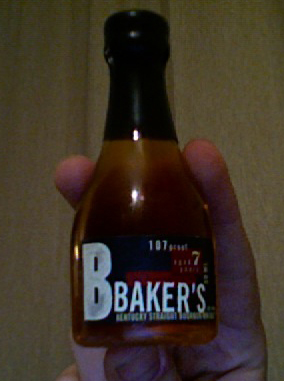
bakersMy little brother was thoughtful enough to give me a sampler for Jim Beam’s Small Batch Bourbon Collection over the holidays, so I saw this as a perfect time to complete my reviews of this line by tasting Baker’s.  (You can find the other’s here: Knob Creek, Basil Hayden, Booker’s)

What does it mean that I’m reviewing something in its mini-bottle form?  Honestly, I’m not too certain either.  Sure, this didn’t make it into the full-bottle batch and this can’t be experienced in the same way that the full bottle could; on the other hand, its the same stuff inside and it seems that Beam has taken great care with the miniature versions of their Small Batch Collection.

Stats:

– Probably a few dollars by itself

– Made by the folks a Jim Beam

– 107 proof

Presentation:

While it’s difficult to judge a bourbon’s bottling when in mini-bottle form, the small batch collection minis do seem to hold largely true to their bigger-bottle form.  Knob Creek mini has its distinctive angular form and Basil Hayden mini has its tall, distinguished proportions.  Baker’s and Booker’s bottles are given a tear-drop form that is only mildly reminiscent of their actual shape, but represent a valiant effort in miniaturization, regardless.

I do remember liking the Baker’s distinctive capital B and use of type during visits to the bar and the mini-bottle uses this same motif to only slightly more confusing effect (the capital ‘B’ is right next to the ‘B’ in “Baker’s” making it look like “BBaker’s”.)

Lines and fills are ever so slightly rough and overly bold in order to mimic an old letter press and come in varying typefaces.  One edge of the label is serrated while the others are smooth.  All in all, this comes across as the older brother of Knob Creek.  Not afraid to stray from the yarns of long-dead grandfathers that adorn other bourbons, but not dispatching with a sense of history over all.

Tasting:

Very upfront nose.  Citrus, grass, roasted almond, fresh cherry.  There is very little subtlety about this aroma, but it is pleasant and un-astringent for a 100+ proofer.

On tasting it’s sweet, with some notes of oats and citrus, finishing with a nice lingering warmth and some tanginess, this settles into a vanilla-and-smoke after a while.

Over all:

Baker’s is not shy.  It is bright for the most part and settles into something a little more subdued over time.  I actually like this one quite a bit – and it may even be my favorite of the small batch collection from Beam.  That said, it also is the one that reminds me the most of Jim Beam black – and that’s not a bad thing in my book.

I’ll have to pick up a full-sized edition when I get a chance.